
Baldwin Boxall OCBRG OmniCALL Type B Refuge Outstation | Two-Way Speech, Hands-Free, BS 5839-9
£325.16 (inc VAT: £390.19)
Key features
- Loop or radial wiring options
- Assistance alarms shown separately at master station
- Self-powered from loop or radial circuit
Downloads
Summary
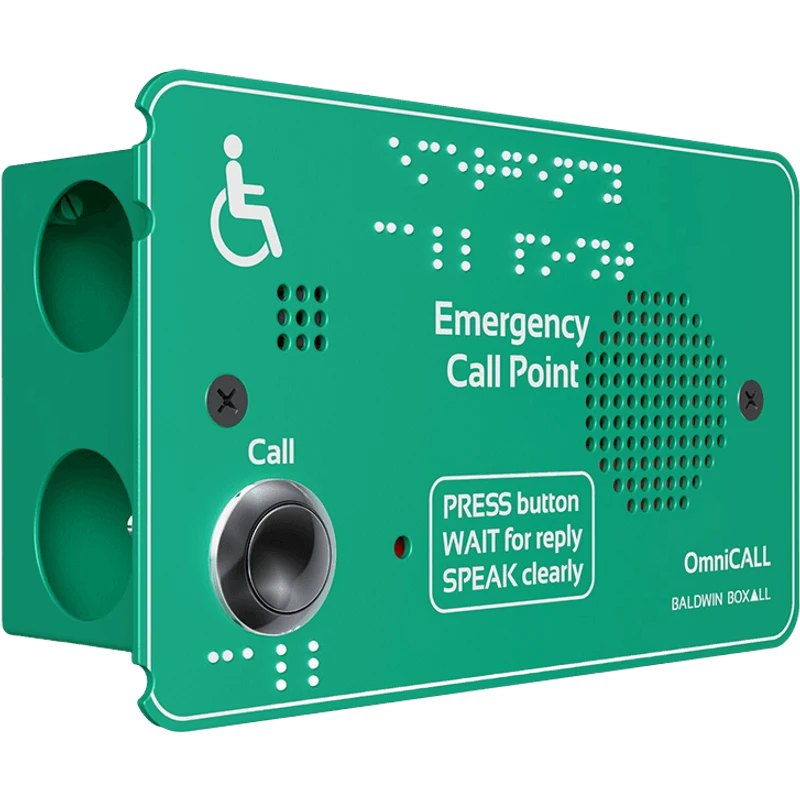
The Baldwin Boxall OCBRG is a Type B refuge outstation built for disabled refuge points, giving anyone awaiting evacuation assistance a direct, hands-free line to the fire control room.
View full overview Show less
For you on site, it takes the wiring headache out of refuge call systems: it’s self-powered straight from the OmniCALL loop or radial circuit, so there’s no need to run a separate mains supply to every refuge point in the building. That cuts installation time and simplifies commissioning, while the two-way speech link and separate assistance alarm indication at the master station help you deliver a system that meets BS 5839-9:2021 and BS 8893:2024.
Fitted into a standard double-gang backbox (47mm depth required) for a flush finish, or onto an optional surface-mount backbox where recessing isn’t practical, the OCBRG green refuge remote suits new-build refuge points and retrofit upgrades alike.
Features
- Two-way, hands-free speech - lets refuge users speak clearly to the control room without holding a handset
- Self-powered from loop or radial circuit - no local power source to install or maintain
- Loop or radial wiring - fits straight into the topology already used on the OmniCALL master station
- Braille and luminescent labelling - keeps the call point usable for visually impaired users and in low light
- Assistance alarms shown separately at master station - lets control room staff tell refuge calls apart from other activations
- Reset via outstation button push - clears the call on site without needing access to the panel
- Optional link to the fire detection system - helps prevent hoax disabled refuge calls
- Output to isolate local loudspeaker - works with an OCSPRISOL unit to mute the local speaker during a refuge call
FAQ
No. It’s self-powered from the OmniCALL loop or radial circuit it’s wired into, drawing 30mA at 24V within its 15-36V supply range, so no separate mains feed is needed at the refuge point. Assistance alarms from the OCBRG are shown as a separate indication on the master station, distinct from other outstation activity, allowing staff to identify and prioritise genuine refuge calls. The OCBRG supports both loop and radial wiring options, giving flexibility in how the refuge network is laid out. Whether it needs a direct interface with the site’s main fire alarm panel depends on the overall system design, so this should be confirmed with Baldwin Boxall or a qualified system designer at the specification stage. It’s rated for use between -5°C and +40°C and up to 90% humidity, non-condensing, which suits most stairwell and refuge point locations including unheated areas. It should not be installed where condensation could form on the unit. Disabled refuge communication systems in the UK are generally installed and tested in line with BS 5839-9, the British Standard covering emergency voice communication (EVC) systems. As this covers wider system design and testing requirements beyond the outstation itself, full compliance should be confirmed against the standard and Baldwin Boxall’s installation documentation.Does the OCBRG need its own power supply?
How does control room staff know a refuge call has been raised, rather than another outstation event?
Can the OCBRG be wired into a loop or a radial circuit, and does it need to interface with the main fire alarm panel?
What environmental conditions is the OCBRG designed to operate in?
Which British Standard applies to installing a Type B refuge outstation like this?
Specifications
| Product Code | OCBRG |
|---|---|
| Power Supply | 15-36V |
| Power Consumption | 30mA @ 24V |
| Humidity Range | 0-90% non-condensing |
| Temperature Range | -5°C to +40°C |
| Indicators | Status |
| Finish | RAL 6024 |
| Dimensions (W x H) | 150 x 90mm |
Downloads
- Datasheet (Adobe PDF)
Additional information
| Device Type | |
|---|---|
| Colour | |
| Enclosure |
More Outstation products from Baldwin Boxall
Baldwin Boxall OCAFRP | OmniCALL Type A Fire Telephone Outstation | Push Door, Full Duplex, BS 5839-9
£447.10 (inc VAT: £536.52)
Baldwin Boxall OCBARG | OmniCALL Type B Advanced Refuge Outstation | Two-Way Speech, BS 5839-9
£487.74 (inc VAT: £585.29)