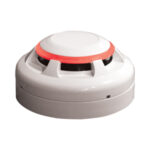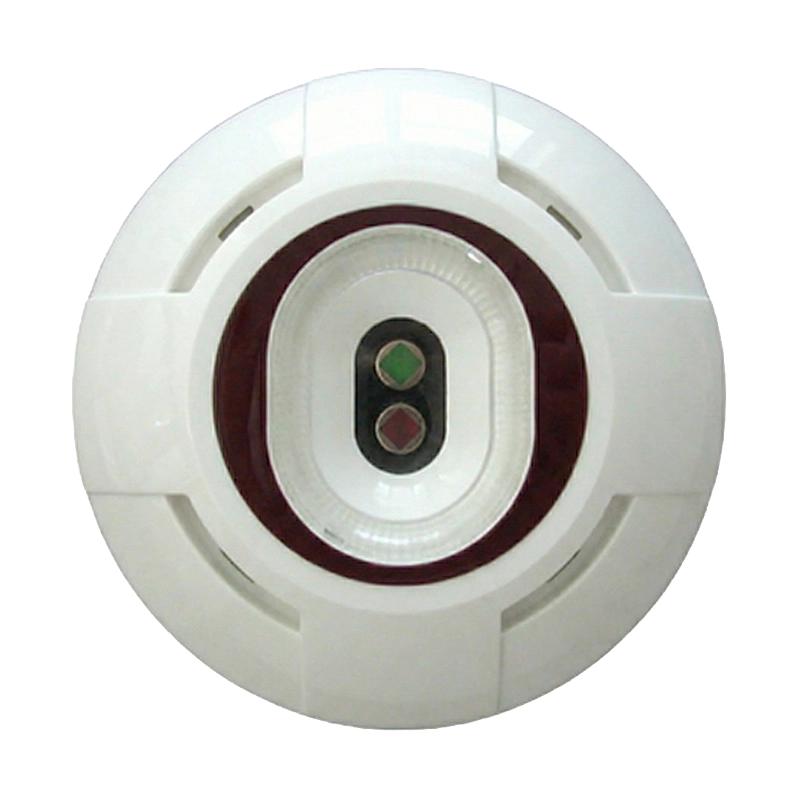

Nittan EVC-IR Conventional Dual IR Flame Detector | Class 1 (25m), Dual Wavelength
£481.82 (inc VAT: £578.18)
You may also need
Key features
- Dual wavelength and flicker frequency sensing for false alarm reduction
- 100-degree supervision angle with 17m coverage at full angle
- 360-degree omni-ring LED indication with self-test glass contamination monitoring
Downloads
Summary
The Nittan EVC-IR is a conventional dual infrared flame detector designed to monitor infrared energy emitted during fire events. Utilising advanced CO2 resonant emission detection combined with dual wavelength and flicker frequency sensing techniques, the detector provides maximum false alarm reduction whilst maintaining high sensitivity to real flaming fires. The sophisticated detection algorithm enables reliable flame identification even in challenging environments with background noise, dust or other distractions.
View full overview Show less
Specifically engineered for large and high-ceiling applications, the EVC-IR excels in areas where traditional heat or smoke detectors cannot provide rapid fire detection. Typical applications include gymnasiums, atriums, aircraft hangars, industrial spaces and machinery monitoring where bearing seizure or other malfunctions could create ignition sources. The detector offers a supervision angle up to 100 degrees with a distance limit of 17 metres at full angle, or extended coverage up to 30 metres when operating at a focused 20-degree angle.
The EVC-IR integrates easily with conventional fire alarm control panels operating between 10V-32V DC, drawing just 130µA in monitoring mode. For addressable fire alarm systems, the detector interfaces seamlessly via zone monitoring modules such as the Nittan EV-ZMU2, which supports up to 5 EVC-IR devices per circuit in fully loop-powered configuration. The detector features a 360-degree omni-ring LED for clear alarm indication, internal fault monitoring via remote LED output, and an adjustable mounting bracket for precise positioning towards detection zones.
Features
- Dual wavelength infrared sensing technology for accurate flame detection
- Flicker frequency algorithm reduces false alarms from non-fire sources
- CO2 resonant emission detection method for fire signature identification
- Supervision angle up to 100 degrees with plus or minus 50-degree coverage
- Maximum supervision distance 30 metres at 20-degree focused angle
- Distance limit 17 metres at full 100-degree supervision angle
- 360-degree omni-ring LED indication visible from all directions
- Self-test function monitors glass contamination automatically
- Internal fault monitoring with remote LED indicator output
- Remote LED pulses once every 4 seconds for contaminated window
- Remote LED pulses twice every 4 seconds for internal sensor fault
- Operating voltage range 10V-32V DC for flexible system compatibility
- Quiescent monitoring current only 130µA for efficient operation
- Alarm current up to 50mA limited by control circuit
- Internal alarm current limiting resistor eliminates external components
- 375 Ohm alarm impedance for conventional panel compatibility
- Compatible with standard Nittan detector bases including UB-4, UB-4-SD and UB-6-EV
- Adjustable mounting bracket available for angled installation
- Detector face can be tilted down at 45-degree angle for optimal coverage
- Compatible with EV-ZMU2 addressable zone monitoring module
- EV-ZMU2 supports up to 5 EVC-IR devices per zone circuit
- 1 second reset time with 4 second power-on initialisation
- MTE2-NK dedicated test tool with infrared test lamp for commissioning
- FZ-007 adapter available for standard detector tester auxiliary rods
- Response time within 30 seconds during test procedures
- Operating temperature range minus 25°C to plus 70°C
- Storage temperature range minus 25°C to plus 70°C
- Relative humidity tolerance up to 95% non-condensing
- IP42 protection rating against solid objects and water ingress
- EN54-10:2002/A1:2005 certification for flame detector performance
- Class 1 sensitivity rating at 25m, Class 2 at 17m, Class 3 at 12m
- Compact dimensions 104mm diameter by 29mm sensor head
- Lightweight construction at 127g for sensor head only
- ABS/PC alloy construction for durability and longevity
- CPR Certificate number 2831-CPR-F2439 for European compliance
- UKCA Certificate number 0832-UKCA-CPR-F0042 for UK market
FAQs
What applications is the EVC-IR flame detector best suited for?
The EVC-IR is specifically designed for large open spaces and high-ceiling areas where traditional heat or smoke detectors cannot provide rapid fire detection. Ideal applications include gymnasiums, atriums, aircraft hangars, industrial warehouses, manufacturing facilities and machinery monitoring. It can also be deployed to monitor equipment where malfunctions such as bearing seizures could create ignition sources, providing early warning before fire develops.
How does the dual wavelength detection technology improve reliability?
The EVC-IR uses two infrared wavelength sensors combined with CO2 resonant emission detection and flicker frequency analysis. This multi-parameter approach enables the detector to distinguish genuine fire signatures from false sources such as sunlight, welding operations, or other infrared sources that might trigger single-wavelength detectors. The sophisticated algorithm significantly reduces false alarms whilst maintaining high sensitivity to real flaming fires.
What is the maximum coverage area for this flame detector?
Coverage depends on the installation angle. At the full 100-degree supervision angle (plus or minus 50 degrees), the detector provides reliable coverage up to 17 metres distance. For longer-range applications, focusing the detector to a 20-degree angle (plus or minus 10 degrees) extends the maximum supervision distance to 30 metres. The detector is classified as Class 1 sensitivity at 25m, Class 2 at 17m, and Class 3 at 12m according to EN54-10 standards.
Can the EVC-IR be used with addressable fire alarm systems?
Yes, although the EVC-IR is a conventional device, it can be integrated into addressable fire alarm systems using a zone monitoring module. Nittan provides the EV-ZMU2 zone monitor which is fully loop powered and can provide 1 Class A circuit or 2 Class B circuits. Each circuit can support up to 5 EVC-IR flame detectors, enabling addressable systems to benefit from the detector’s advanced flame sensing capabilities.
What installation considerations are important for the EVC-IR?
The detector must be aimed towards the centre of the detection zone with an unobstructed view. The detector face should ideally be tilted down at a 45-degree angle for optimal coverage. Avoid locations with direct sunlight, vibration, corrosive gases, high temperatures, steam, condensation or areas where flames are normally present such as kitchens. Transparent obstacles including windows, glass or plastics must not obstruct the detection path as they will interfere with infrared sensing.
How does the internal fault monitoring feature work?
The EVC-IR provides diagnostic information through a remote LED indicator output. When connected, the remote LED shows continuously during fire alarm conditions alongside the device omni-ring light. If the detector window becomes contaminated with dirt, the remote LED pulses once every 4 seconds, indicating cleaning is required. If the internal sensor develops a fault, the remote LED pulses twice every 4 seconds, indicating the device needs replacement. Note that these fault conditions are indicated locally but not transmitted to the zone circuit.
What test equipment is required for commissioning the EVC-IR?
The detector requires the Nittan MTE2-NK dedicated test tool, which is specifically designed for infrared flame detector testing. This battery-powered tester incorporates an infrared test lamp that simulates flame characteristics. An FZ-007 adapter is available for connecting the tester to standard detector auxiliary rods. The tester is held within 1cm of the detector and should trigger an alarm response within 30 seconds during commissioning procedures.
What voltage range does the EVC-IR operate on?
The detector operates from 10V-32V DC, providing compatibility with a wide range of conventional fire alarm control panels. The standard system voltage is 24V DC. The detector draws a minimal quiescent current of 130µA during normal monitoring and up to 50mA during alarm conditions, limited by the control circuit. The internal alarm current limiting resistor provides a 375 Ohm alarm impedance.
What detector bases are compatible with the EVC-IR?
The EVC-IR is compatible with standard Nittan detector bases including UB-4, UB-4-SD, UB-6-EV, STB-4SE, STB-4-SE-EV and STB-4SE-SD. An adjustable mounting bracket is available separately to accommodate angling the device towards the detection zone. The detector base screws to the adjustable bracket and cable can be pulled through the bracket to connect with the base.
What environmental conditions can the EVC-IR withstand?
The detector operates reliably in temperatures from minus 25°C to plus 70°C and can tolerate relative humidity up to 95% non-condensing. The IP42 protection rating provides protection against solid objects larger than 1mm and water dripping at angles up to 15 degrees from vertical. However, direct exposure to steam, water vapour, condensation or corrosive gases should be avoided to ensure optimal performance and longevity.
How often should the EVC-IR be maintained?
The detector requires minimal maintenance in normal usage. Regular testing should be conducted as part of the normal fire alarm system maintenance schedule. Periodic checks should verify the detector remains properly aligned with the detection zone and the window should be carefully cleaned with a soft cloth when necessary. The self-test function continuously monitors for glass contamination, providing early indication when cleaning is required.
Specifications
- Part Number: EVC-IR
- Computer Reference Number: F04J60044
- Sensor Method: CO2 resonant emission, flickering, dual wavelength
- Sensor Element: 2 x infrared wavelength sensors
- Sensor Class: Class 1 (25m), Class 2 (17m), Class 3 (12m)
- Supervision Angle: 100 degrees maximum (±50 degrees)
- Distance Limit (Full Angle): 17 metres at 100 degrees
- Maximum Supervision Distance: 30 metres at 20-degree angle (±10 degrees)
- Operating Voltage: 10V-32V DC
- System Voltage: 24V DC
- Quiescent Current: 130µA (100µA typical)
- Alarm Current: 50mA @ 24V (limited by control circuit)
- Alarm Impedance: 375 Ohms
- Remote LED Indicator Current: 2mA
- Reset Time: 1 second
- Power On Reset Time: 4 seconds
- Charging Time: 30 seconds
- Response Time (Test): Within 30 seconds
- Omni-Ring Indication: 360 degrees
- Internal Current Limiting: Yes
- Glass Contamination Self-Test: Yes
- Operating Temperature: -25°C to +70°C
- Storage Temperature: -25°C to +70°C
- Relative Humidity: ≤95% non-condensing
- IP Protection Rating: IP42
- Material: ABS/PC alloy
- Dimensions (Sensor Head): Ø104mm x 29mm
- Dimensions (With Base): Ø104mm x 45mm
- Weight (Sensor Head): 127g
- Weight (With Base): 186g (150g typical)
- Compatible Bases: UB-4, UB-4-SD, UB-6-EV, STB-4SE, STB-4-SE-EV, STB-4SE-SD
- Addressable Interface: EV-ZMU2 zone monitor module
- Maximum Devices Per Circuit (EV-ZMU2): 5 EVC-IR detectors
- EV-ZMU2 Configuration: 1 x Class A or 2 x Class B circuits
- Test Tool: MTE2-NK with FZ-007 adapter
- Approval Conformance: EN54-10:2002/A1:2005
- CPR Certificate Number: 2831-CPR-F2439
- UKCA Certificate Number: 0832-UKCA-CPR-F0042
- DoP Number: F2439
- Manufacturer: Nittan Europe Ltd
Downloads
- Datasheet (Adobe PDF)
- Guidance Notes (Adobe PDF)
Additional information
| Weight | 0.13 kg |
|---|---|
| System Type | |
| Device Type | |
| Detection Type | |
| Wavelength | IR2 |
| Hazardous Applications |