Updated 5 November 2026. Placement examples checked against the Aico Ei208 instructions, with current HSE and GOV.UK guidance for the workplace and rented-home sections.
Place a carbon monoxide alarm where its manufacturer specifies for the room and the potential CO source. A room containing a boiler or other fuel-burning appliance can need a different alarm position from a bedroom without an appliance. Mounting height, distance from walls and the ability to hear the warning all matter.
This guide explains boiler distance, ceiling and wall mounting, rooms to consider and workplace responsibilities. The measurements in the illustrated examples apply to the Aico Ei208 family. Check the installation manual supplied with your exact alarm before fitting it.
Jump to placement examples, how many alarms you need, workplace guidance, product examples or testing and maintenance.
Start with the room and the potential source
Carbon monoxide can be produced by fires and appliances that burn gas, wood, oil or coal. It cannot be detected by smell. An alarm provides a warning, while safe installation, servicing and ventilation help control the source of the risk. A boiler room, a sleeping room and a commercial plant area need their own assessment.
For gas appliances at work, HSE’s employer guidance covers competent installation and maintenance, regular servicing of gas fittings and adequate ventilation. Keep those controls in place alongside the chosen detection arrangements.
How far should a carbon monoxide alarm be from a boiler?
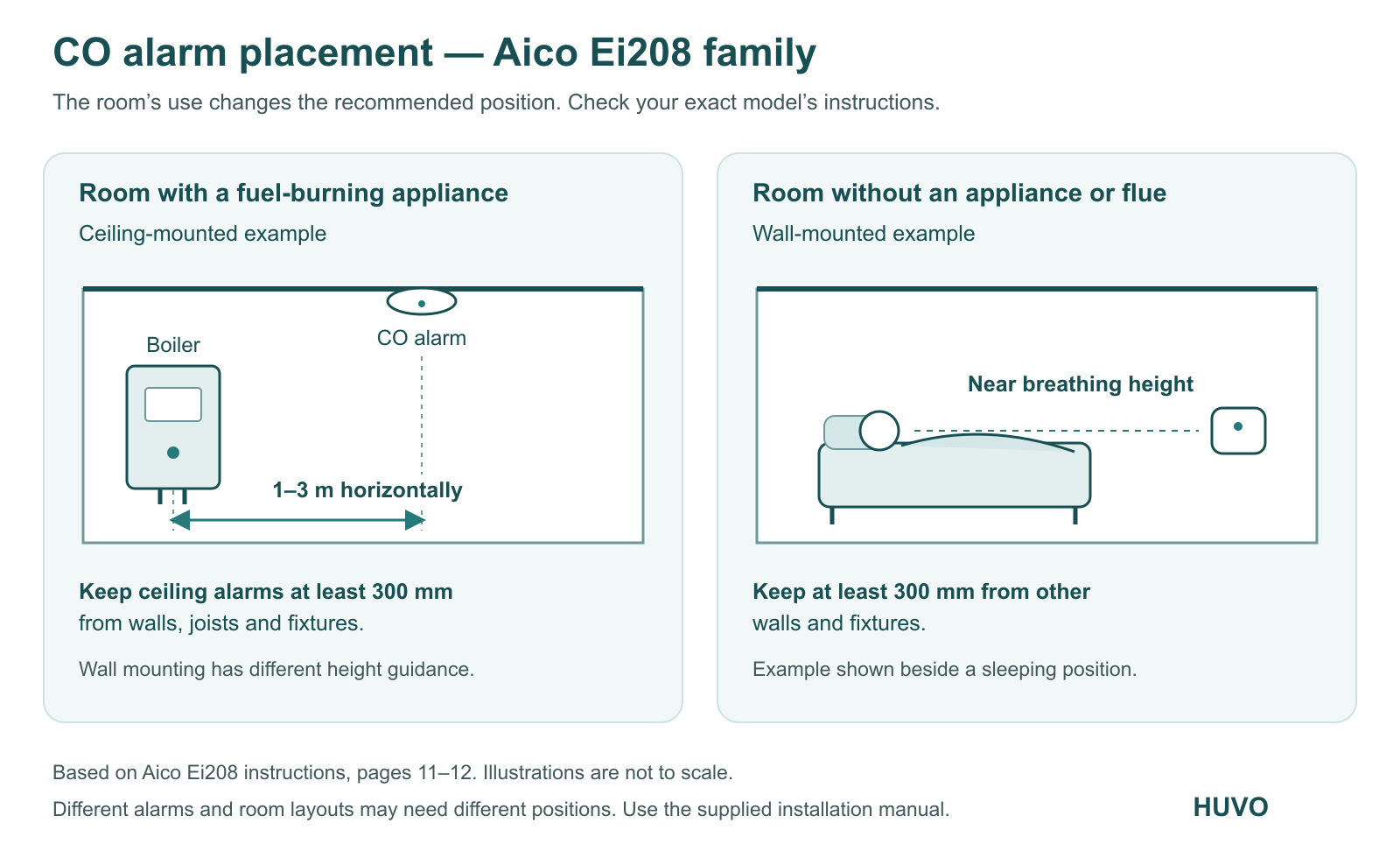
For the Aico Ei208 family, the instructions specify a horizontal distance of 1–3 metres from the potential CO source in a room containing a fuel-burning appliance. Measure across the room when planning the position. Where a partition divides the room, the alarm belongs on the same side as the appliance.
| Room and mounting option | Position to check | Important detail |
|---|---|---|
| Appliance room, ceiling mounting | 1–3 m horizontally from the potential CO source. | At least 300 mm from walls, joists and fixtures. |
| Appliance room, wall mounting | 1–3 m horizontally from the source, above the height of doors and windows. | 150–300 mm below the ceiling. |
| Room with a sloped ceiling | At the high side of the room, following the manual’s diagram. | Apply the manufacturer’s clearance requirements. |
| Room without an appliance or exhaust flue | Wall mounting close to the occupants’ breathing height. | At least 300 mm from other walls and fixtures. |
300 mm is 30 cm. Keep the distinction between the ceiling clearance and the wall-mounted distance below the ceiling. The correct position depends on both the room and the mounting option.
How many carbon monoxide alarms do you need?
Work through the layout, fuel-burning appliances, flue routes and occupants’ ability to hear an alarm. A simple count of floors does not establish the right CO alarm coverage. The manufacturer’s installation guidance and the requirements for the building should inform the final arrangement.
| Situation | What to check |
|---|---|
| Rooms with fuel-burning appliances | The Aico instructions recommend an alarm in each room containing a fuel-burning appliance. |
| Sleeping rooms and regularly occupied rooms | Consider warning audibility with doors closed. The Aico instructions discuss additional or interconnected warnings for occupants elsewhere in the dwelling. |
| An extended or concealed flue | The Aico instructions call for an alarm in each room through which the flue passes. |
| A remote boiler or plant room | Check how people elsewhere will receive the warning. Any interconnection, sounder, beacon or relay interface must be compatible with the selected equipment. |
| Commercial premises | Assess the appliances, processes, occupied areas and response arrangements for the particular site. |
A standalone alarm and an interconnected model provide different warning arrangements. The Aico Ei208 is a standalone unit. If the design needs warnings in other rooms, confirm the exact compatible equipment and configuration before ordering.
Where should you avoid putting a CO alarm?
Read the unsuitable-location section of the exact model’s instructions. For the Ei208 family, points to check include:
- Enclosed or obstructed positions, including inside a cupboard or behind curtains and furniture.
- Positions beside extractor fans, draughty doors, windows or air vents.
- Directly above a sink or cooker, or close to heat sources.
- Dust, dirt, splashing water or condensation that could affect the sensor.
- Temperature and humidity outside the limits stated for the alarm.
Bathrooms and other damp rooms need particular care. The Ei208 instructions include a bathroom-specific qualification and restrictions on splashing and condensation. Check the chosen alarm’s suitability and exact position with the installer.
Carbon monoxide alarms in workplaces and rented homes
For workplaces, start with the risks from the appliances and processes on the site. HSE requires employers to address gas safety through competent work, maintained appliances and flues, and suitable ventilation. Industrial and commercial equipment must be designed, operated and maintained to prevent dangerous CO levels. Detection, warning and any ventilation or shutdown interfaces should suit that assessment.
The alarm specification also matters. Check the manufacturer’s intended application, documented approvals, supply and outputs. A household alarm’s product description alone does not establish its suitability for a commercial plant or process installation.
For rented homes in England, the government’s guidance says a CO alarm is required in a room used wholly or partly as living accommodation that contains a fixed combustion appliance, with gas cookers excluded from that particular requirement. It also directs landlords to follow the individual manufacturer’s installation instructions. See the official England guidance for its scope and exclusions. Check the rules that apply to the building’s location and use.
Choosing the alarm and its power supply
Plug-in alarms
Check whether the model’s instructions permit the proposed socket position and mounting arrangement. The available power point needs to suit the alarm’s required location.
Battery-operated alarms
Check whether the battery is replaceable or sealed, the stated service life and the warning arrangement. A sealed-battery alarm still needs the testing, cleaning and eventual replacement specified in its manual.
Mains-powered and relay-output models
Confirm the supply requirements, backup provisions and any interconnection or relay functions for the exact model. An external output needs a compatible system design and installation.
Carbon monoxide alarm examples at Huvo
These examples show different power and output arrangements. Select equipment against the intended application and the manufacturer’s instructions.
| Model | Verified features | Check before choosing |
|---|---|---|
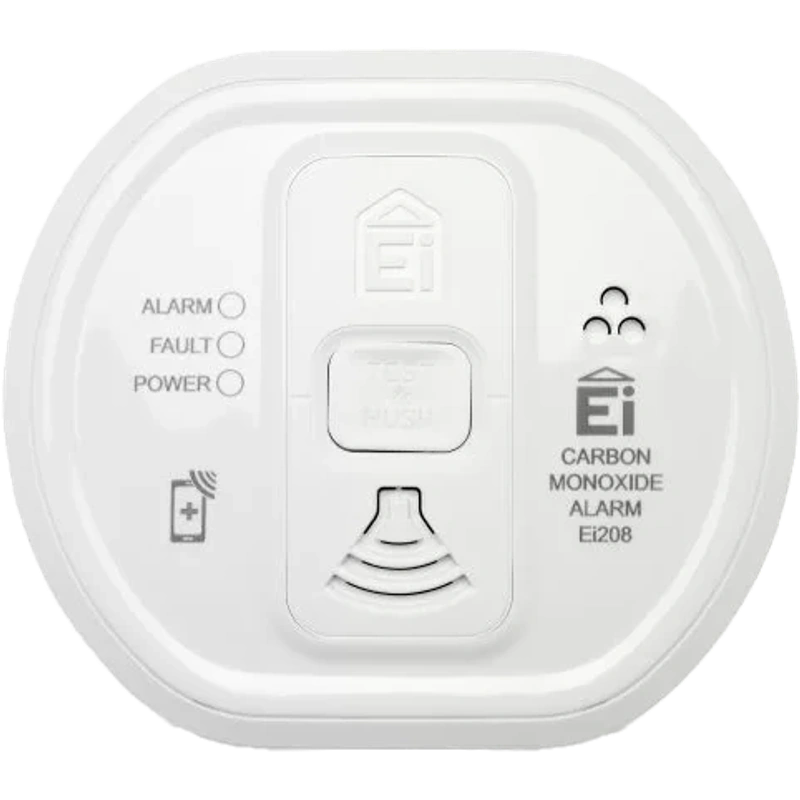
| Aico Ei208 | Standalone CO alarm with a sealed lithium battery and 10-year stated battery lifespan. | Use the Ei208 placement and test instructions. The standalone unit provides its warning locally. |
| Hispec HSA/BC/10 | Electrochemical sensor and a sealed lithium battery with a 10-year stated life. | Use the Hispec instructions for its location and maintenance. See the datasheet. |
| Zeta CO200 | 230 V AC or 9–28 V DC supply and two-stage relay outputs. | Confirm the application, supply and external interface requirements. See the datasheet. |
Hispec HSA/BC/10
The Hispec example provides a sealed-battery option with an electrochemical sensor. Check the exact HSA/BC/10 reference when ordering or replacing an existing alarm.
Zeta CO200
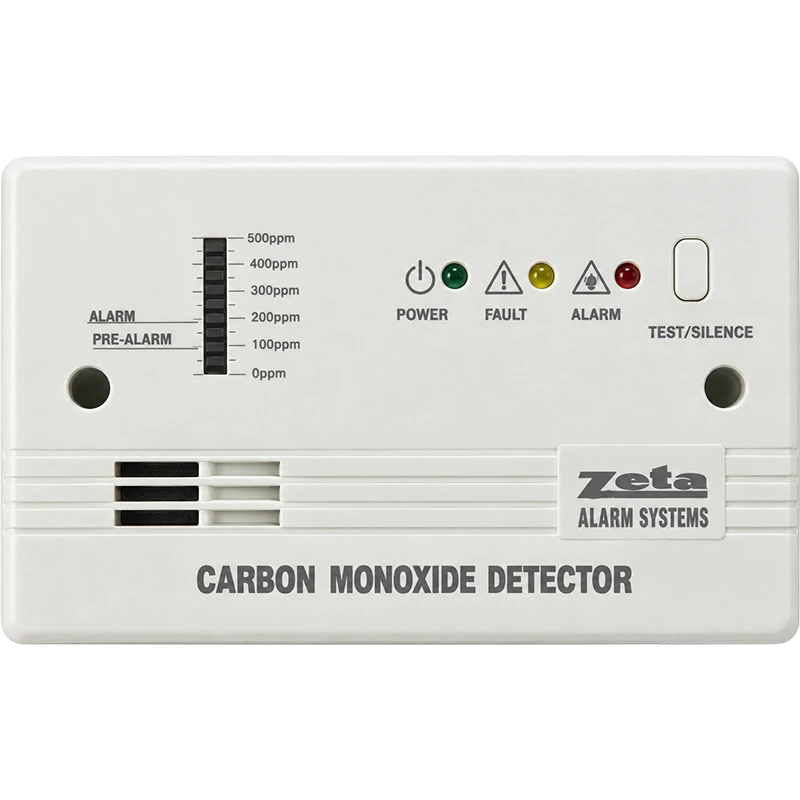
The CO200’s output arrangement is a reason to check the complete system specification. Confirm the required detector functions and compatibility with any connected equipment.
Testing and maintaining a CO alarm
Follow the test method and interval in the manual for the exact alarm. For the Aico Ei208 family, the manufacturer specifies button testing after installation, monthly thereafter, after prolonged absence and after relevant repairs or electrical work. Its instructions say to hold the test button for at least five seconds.
The Aico manual warns that testing with CO gas can give misleading results without special apparatus. Use the manufacturer’s approved procedure for the device. Specialist gas testing needs the equipment and procedure specified for that alarm.
Keep a maintenance record where required by the site’s arrangements, respond to fault and end-of-life warnings, and replace the alarm when its manufacturer specifies. The alarm’s instructions also describe suitable cleaning and substances to keep away from the sensor.
CO alarm placement questions
Should a carbon monoxide alarm be on the ceiling or wall?
Check the model and room. The Ei208 instructions show both options in an appliance room, with different height and clearance requirements. In a room without an appliance or flue, they show wall mounting close to breathing height.
Can a CO alarm go inside a boiler cupboard?
The Ei208 instructions list an enclosed space such as a cupboard as unsuitable. Ask the installer to identify a suitable position for the alarm and appliance arrangement.
Does one alarm cover the whole building?
The number and positions depend on sources, flue routes, room layout and warning audibility. Review those factors and the manufacturer’s coverage guidance before relying on a single alarm.
What to do if the alarm sounds
Follow the alarm’s emergency instructions. If you suspect CO exposure, the NHS advises going outside, stopping use of suspected appliances if you can, and getting medical advice promptly. Get help from a safe place and follow the site’s evacuation arrangements.
For suspected CO exposure with difficulty breathing, loss of consciousness, weakness or chest or muscle pain, the NHS advises calling 999. Read the NHS carbon monoxide guidance for its emergency and NHS 111 advice. Have the source investigated and affected appliances checked before using them again.