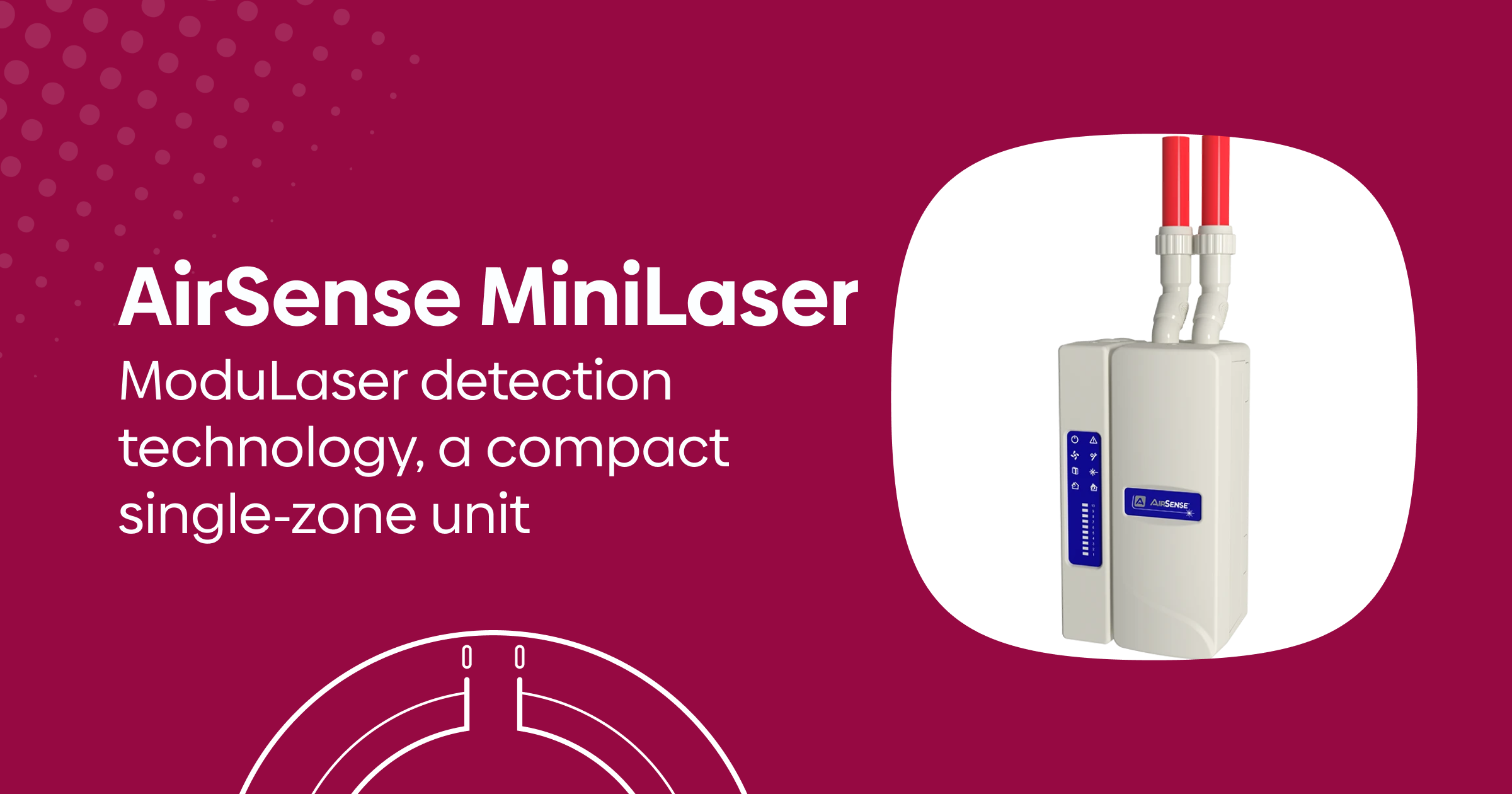
Not every job that needs aspirating detection needs a multi-zone system.
A server room, lift shaft, archive store or small clean room often calls for one detector, one pipe run and a budget that will not stretch to a full multi-channel system.
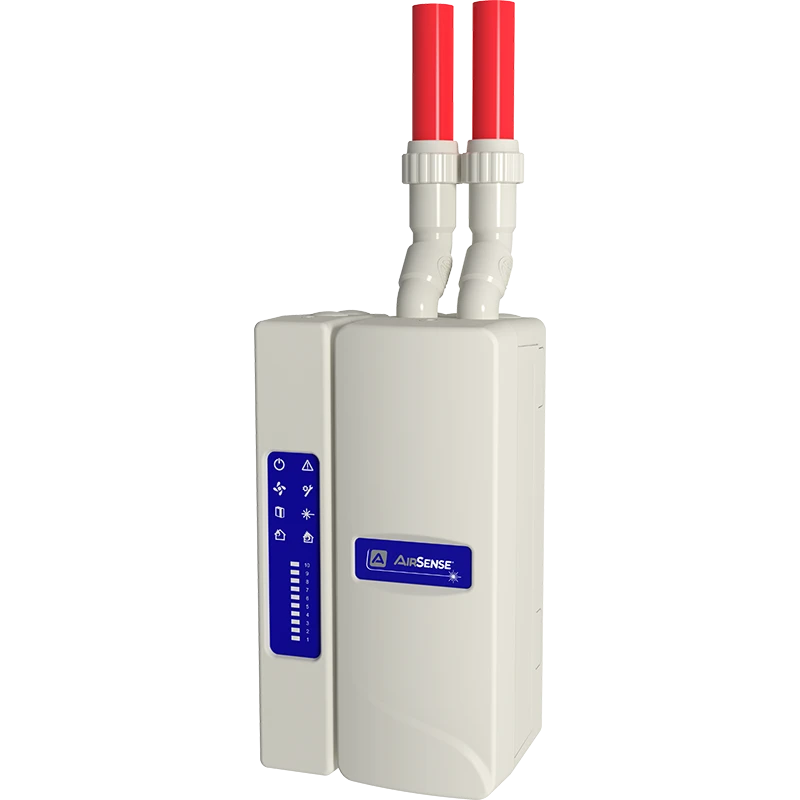
The AirSense MiniLaser from Kidde Global Solutions is built for exactly that gap: ModuLaser detection technology in a compact, single-zone unit that is quick to fit and simple to commission.
What the MiniLaser does for your next install
Cuts time on site. A clip-in docking station takes all the first-fix wiring, the electronics go in last, and AirSense puts the saving from the tool-less pipe collars at up to 30 minutes per unit.
Commissions without a laptop. DIP-switch configuration covers simple pipe layouts using predefined designs. For anything more complex, PipeCAD modelling via USB-C is there when you need it.
One SKU covers Class A, B and C. Four adjustable alarm levels and EN 54-20 approval across all three classes mean less stock to carry and fewer specification headaches.
Same detection engine as ModuLaser. Laser forward-scattering detection with ClassiFire environmental compensation gives early warning without the nuisance-alarm problems that can put some clients off aspirating smoke detection.
Where it fits in the AirSense range
AirSense positions the MiniLaser as a cost-effective, low-to-mid range option beneath the ModuLaser.
Where ModuLaser is built for multi-zone projects, the MiniLaser strips that back to what a single-zone application actually needs. ModuLaser gives you clusters of up to eight detector modules on one display, 250m of pipe per module, a colour TFT display, RS485 networking and Modbus or APIC integration.
The MiniLaser is simpler by design.
Think of it as the entry point to the range rather than a cut-down compromise. The optical chamber, ClassiFire algorithm, waste-gate airflow design and filter are shared with ModuLaser. What changes is the scale and the interface.
Detection performance
The MiniLaser samples air continuously through a pipe network and analyses it in a laser-based optical chamber optimised for the very small particles produced in the earliest stage of a fire.
Key figures include:
- Sensitivity range: 0.002 to 25 %obs/m
- Particle sensitivity: 0.003 to 10 microns
- Alarm levels: Aux, Pre-alarm, Alarm and Alarm 2
- Coverage: up to 1,600m² per detector, subject to local approvals and installation standards
That coverage sits comfortably within the 2,000m² maximum floor area for a single detection zone under BS 5839-1.
ClassiFire runs a 15-minute learning process on start-up, then operates at reduced sensitivity over the first 24 hours while it settles to the most stable threshold for the environment.
From then on, it continually adapts. That is what lets the same detector work in a dusty warehouse and a climate-controlled data hall without constant retuning.
Pipe network and coverage
The MiniLaser supports up to 125m combined sampling pipe per detector.
Sampling holes are designed to EN 54-20, with up to 10 holes for Class A, 20 for Class B or 35 for Class C per detector. The number you can actually use on a given job depends on the class required, transit time and pipe layout, so anything beyond a simple run should be modelled in PipeCAD.
The quick-fit adaptor accepts 25mm or 3/4 inch pipe, with a two-part flexible construction that twists to take up minor misalignment. Pipe entry can be from the top or bottom, and the detector module mounts at 0 degrees or 180 degrees to suit the installation.
Small details, but useful ones when you are trying to make the pipework fit the building rather than the other way round.
Installation and commissioning
This is where the MiniLaser earns its keep on a job.
The detector module, docking station backplane and display sub-module all come together as one kit under part 9-30501, so there is nothing extra to order for a standard install.
First fix: the docking station backplane clips to a DIN rail or screws to the wall, with cable entry available at the top, bottom and rear through 20mm knockouts. All field wiring terminates in the backplane, so the sensitive detector electronics stay boxed until second fix.
Second fix: the detector module slides in from the front with no jumpers or adjustments. The display sub-module and, if fitted, the expansion housing can sit on either side of the detector to suit the wiring run.
Commissioning: for straightforward pipe layouts, set the DIP switches and go. The inputs and outputs run with preloaded default behaviour, so the unit works predictably out of the box. Where the pipe network needs proper modelling, connect over USB-C and use PipeCAD. An automatic flow-balancing wizard helps reduce set-up time.
The MiniLaser runs from 18 to 30V DC. Current draw is 180mA at the default fan speed 4, 120mA at speed 1 and 365mA at speed 10.
Interfacing with the fire panel
Out of the box, the MiniLaser gives you one supervised input and three volt-free relay outputs: two programmable, one fixed for fault.
Contacts are rated 2A at 30V DC and can be normally open or normally closed.
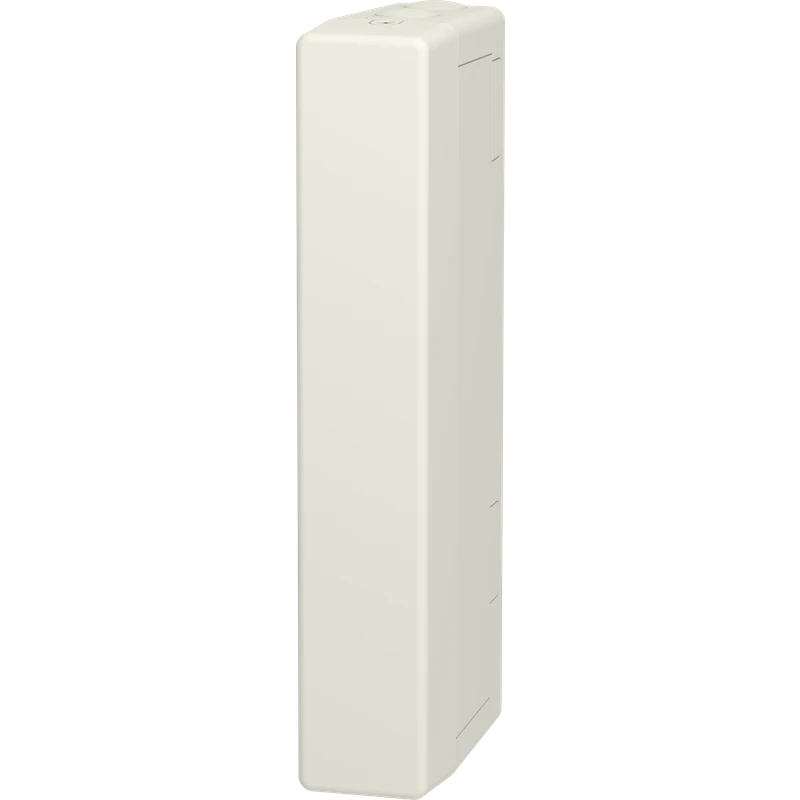
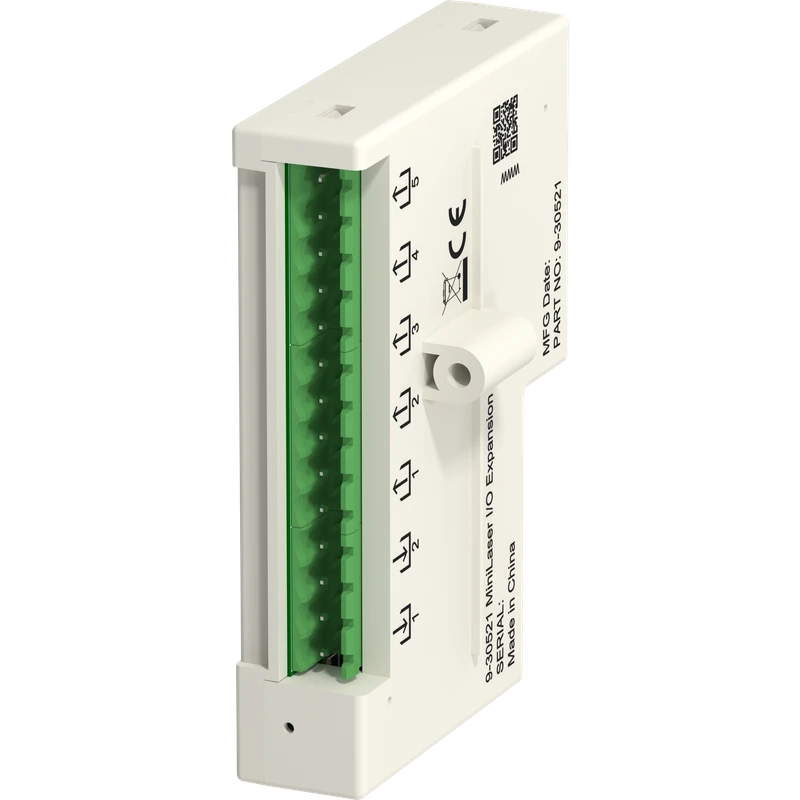
If the job needs more, the optional expansion housing, part 9-30520, clips to either side of the detector and accepts up to two functional modules.
The input/output module, part 9-30521, adds two supervised inputs and five latched relay outputs per module. That is enough to report all four alarm levels plus fault to the panel individually, which some specifications require.
It can also bring in remote reset, day/night mode changeover or ClassiFire Override from the panel or a building management system.
ClassiFire Override is worth knowing about. It temporarily reduces the detector’s sensitivity by a pre-set percentage on demand, so a theatre’s stage effects or a heritage building’s open fire do not generate unwanted alarms while full aspirating smoke detection continues in the background.
Servicing and long-term reliability
The MiniLaser is built with maintenance in mind.
All wiring terminals are front-accessible, so live testing and maintenance do not mean powering down or dismantling the unit. Continuous airflow monitoring flags blocked sampling holes, broken pipe and abnormal flow.
A 20,000-event log and built-in chart recorder give you the evidence base for fault-finding and periodic inspection. The chart recorder can sample from 1 second to 60 seconds, with up to five years’ history.
The PipeCAD design file is stored in the detector, so the pipe design is recoverable years later even if the original paperwork is not.
The 10/90 waste-gate airflow design and multi-layer dust filter help extend maintenance intervals. The replacement filter, part 9-30699N, or 9-30699N-P for a pack of six, is the same one used across ModuLaser and HSSD2, so one spare covers the whole AirSense range.
There is also a local reset button on the unit.
Where installers are fitting it
AirSense’s target applications for the MiniLaser cluster around four groups:
- Plant and building services: lift shafts, electrical switch rooms and pharmaceutical storage, where a single detector covers a compact space that point detection can struggle to reach or maintain.
- IT and data: server rooms, boutique data halls, network operations centres and telecoms rooms that need reliable early warning without the cost of a multi-zone system.
- Specialised environments: clean rooms, laboratories and cold-chain storage, where the detector can sit outside the protected space and only the pipework goes in.
- Heritage and high-value assets: museums, archives, art galleries and historic buildings where detection needs to be discreet and the contents are irreplaceable.
A typical example would be a small data hall with a 300m² floor area.
One detector is mounted in the adjacent plant room, where it is accessible for service, with a single Class A pipe run and up to 10 sampling holes across the ceiling void.
That means no detectors in the protected space, no access requests to a secure room for routine maintenance, and a pipe run that can be commissioned from DIP switches without opening a laptop.
For single-zone aspirating detection, that is the appeal of the MiniLaser: the core ModuLaser detection platform, scaled for smaller jobs where simplicity, cost and commissioning time all matter.