Updated 5 November 2026. Manufacturer specifications and the regulatory sources below have been checked for this refresh.
A fluorine-free foam fire extinguisher provides a way to specify foam protection without the fluorinated chemistry used in traditional AFFF formulations. Check the exact agent, fire rating and intended application when choosing a PFAS-free replacement.
CheckFire describes the Commander models compared below as PFAS-free, fluorine-free foam extinguishers. Their full model codes matter. A 6-litre or 9-litre capacity alone does not identify the fire rating, weight or approval of a particular extinguisher.
Jump to current rules, the 6- and 9-litre comparison, shop the models or replacing an AFFF extinguisher.
What does PFAS-free mean for a fire extinguisher?
PFAS are a large family of synthetic chemicals valued for properties including resistance to heat, water and oil. Their persistence in the environment has prompted restrictions on particular substances and broader action on their use in firefighting foam. The government’s PFAS Plan explains that wider context.
For an extinguisher purchase, check the manufacturer’s statement for the exact product and extinguishing agent. Keep the datasheet and relevant safety data sheet with the equipment information. A fluorine-free formulation still needs the handling, servicing and waste arrangements specified for it.
AFFF, fluorine-free foam and PFAS
| Term | Meaning | What to check |
|---|---|---|
| AFFF | Aqueous film-forming foam, traditionally formulated using fluorinated substances. | Identify the actual agent and its composition before deciding how existing stock is affected. |
| Fluorine-free foam / F3 / FFF | A foam formulation described as fluorine-free. | Confirm the manufacturer’s formulation statement, fire rating and approved application. |
| PFAS-free | A product or formulation claim about the absence of PFAS. | Match the claim to the exact model and supporting documentation. |
| PFOA, PFOS and PFHxS | Specific substances or substance groups within the wider PFAS family. | Check the applicable substance-specific rules as well as broader PFAS measures. |
What are the current PFAS rules for foam extinguishers?
Rules checked 5 November 2026. Existing restrictions on particular PFAS and proposals covering the wider family need to be considered separately. The EU measure also distinguishes placing an extinguisher on the market from using equipment already in service.
| Scope | Verified position | Practical implication |
|---|---|---|
| UK government POPs guidance — PFOA | The firefighting-foam exemption ended on 4 July 2025. GOV.UK says use of the affected foams and contaminated systems was banned from 5 July 2025. | Check whether an existing agent contains regulated substances above the applicable limits. A wider PFAS transition date does not override an earlier substance-specific restriction. |
| Great Britain — wider PFAS firefighting-foam restriction | HSE has published its restriction work and consulted on a socioeconomic opinion. The government’s published plan expects a decision on implementing the proposal in 2027. | Distinguish this policy process from an enacted blanket GB replacement deadline. |
| EU — placing portable extinguishers on the market | Regulation (EU) 2025/1988 specifies a transition ending 23 October 2026 for ordinary PFAS-containing foam in portable extinguishers, and 23 April 2027 for alcohol-resistant foam. | Check the foam type, applicable concentration limits and placing-on-market duties for the destination market. |
| EU — use in existing portable extinguishers | The same regulation provides a use transition until 31 December 2030, subject to its scope and the other applicable restrictions. | The supply and use milestones are different. Confirm the rules for the actual agent and equipment. |
The broader EU restriction uses a threshold of 1 mg/L for the sum of all PFAS. Existing rules for specific substances and other conditions also apply. Read the official EU regulation, particularly Annex entry 82, paragraphs 1–6, for the full scope and exceptions.
The UK sources are GOV.UK’s POPs guidance, HSE’s PFAS firefighting-foam restriction process and the PFAS Plan. For Northern Ireland or cross-border supply, confirm which chemicals regime and market duties apply to the particular transaction.
Compare Commander 6- and 9-litre fluorine-free foam extinguishers
These are the Commander FX-FFF-006-DCF and FX-FFF-009-DCF. CheckFire’s current product pages confirm their PFAS-free formulation and respective 21A 144B and 27A 183B ratings.
| Specification | Commander 6 litre | Commander 9 litre |
|---|---|---|
| Model code | FX-FFF-006-DCF | FX-FFF-009-DCF |
| Capacity | 6 litres | 9 litres |
| Fire rating | 21A 144B | 27A 183B |
| Manufacturer-listed weight | 9.25 kg | 13.34 kg |
| Temperature range | 5°C to 60°C | 5°C to 60°C |
| Dimensions, H × W × diameter | 530 × 295 × 170 mm | 605 × 305 × 195 mm |
See the manufacturer datasheet for both models. The current manufacturer pages for the 6-litre Commander and 9-litre Commander corroborate the model codes and ratings.
Match the fire classes and rating
The A and B ratings identify tested performance for combustible solids and flammable liquids. Select the extinguisher against the site’s fire risks and specification. For cooking oils, specialist fuels, electrical hazards or other applications, confirm the exact extinguisher and approved use with the service provider. A general Class A/B description does not establish suitability for every fuel or setting.
Consider handling and the installation environment
The 9-litre model has the higher listed A/B rating and a greater listed weight. Consider who will handle the unit, its location and the protection specified for the premises. Both models’ stated lower operating limit is 5°C, which matters when assessing unheated locations.
CheckFire lists corrosion-resistant construction, a protective base skirt and spare-parts availability. Keep servicing arrangements tied to the exact model and agent.
Check the required approvals
CheckFire states that these Commander models are Kitemarked to BS EN3. For marine work, obtain current MER/MED evidence for the exact model before specifying it. The February 2025 datasheet labels marine approval as pending, so that older document alone cannot establish its current status.
Shop the verified Commander models
Use the product cards to check the current price, availability and full product details for the model you need.


Can you replace or refill an existing AFFF extinguisher?
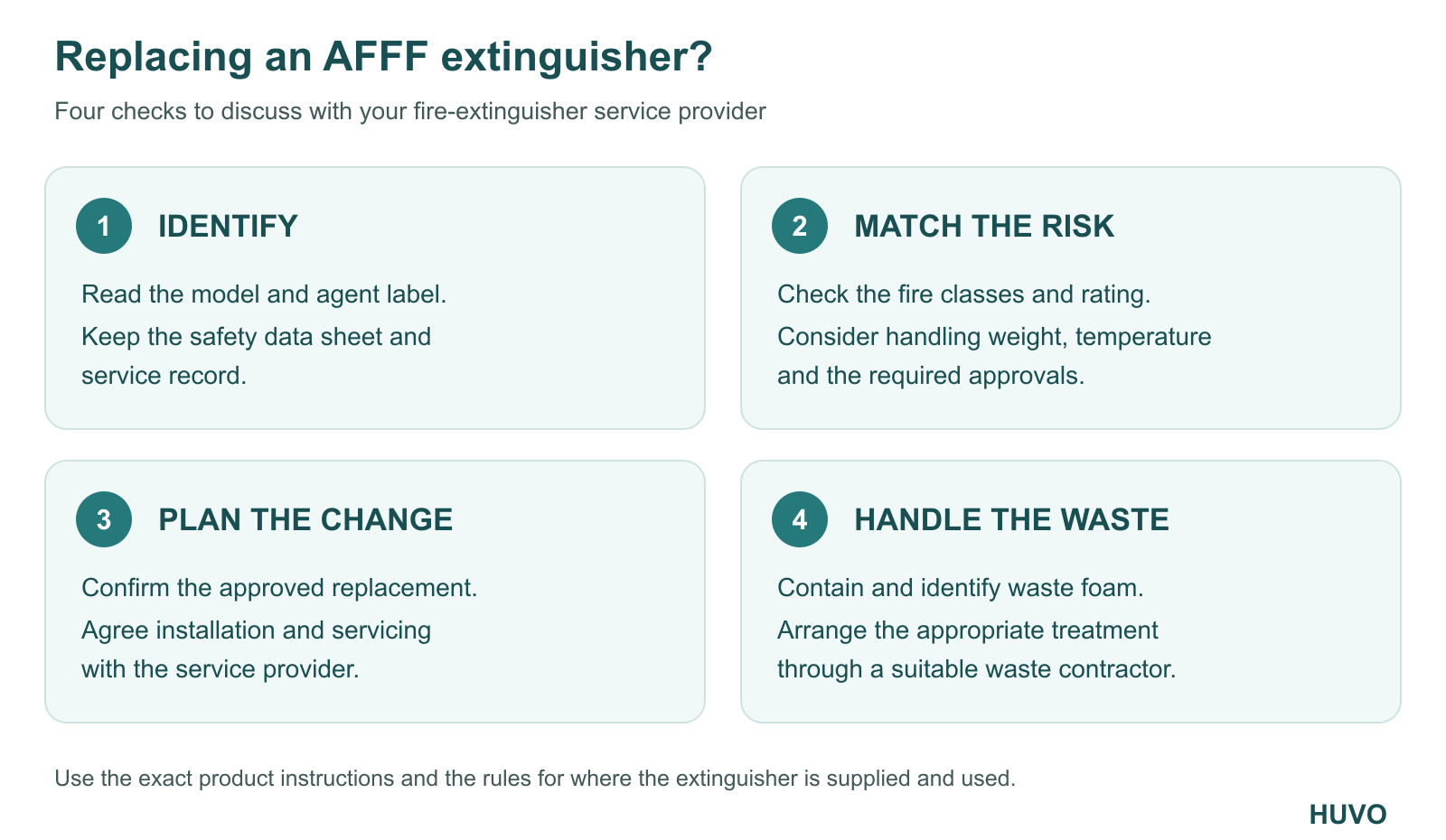
Begin with the existing model code, agent label, service history and available safety data. Ask the servicing provider to confirm the fire risks, required rating and approved replacement. The replacement should suit the installation, handling and environmental conditions as well as the agent requirements.
If reuse or a change of agent is being considered, get the manufacturer’s approved procedure and the service provider’s assessment. PFAS residues can remain in equipment after cleaning, as the EU regulation explains. The proposed replacement agent, cleaning method and equipment compatibility all need checking.
Arrange the waste route before removing old foam
Have the old agent and any contaminated equipment assessed, contained and handled through the appropriate waste route. Arrange this with the servicing provider and a suitable waste contractor. Discharging the foam is not a disposal method.
Where waste contains POPs above the applicable limits, the government’s guidance requires destruction or irreversible transformation of the POP content. Any recovery of other materials must follow those requirements. See GOV.UK’s POPs waste guidance.
Fluorine-free extinguisher questions
Are foam extinguishers banned in the UK?
Check the actual formulation and the rule that applies. Specific substances such as PFOA are already restricted, while Great Britain’s wider PFAS firefighting-foam restriction is a separate process. The EU timetable has its own placing-on-market and use milestones. Use the current-rules table above as the starting point for checking existing equipment.
Can a fluorine-free extinguisher simply replace an AFFF unit?
Confirm the model, fire rating, application and service arrangements before changing it. A replacement needs to satisfy the site’s specification and the manufacturer’s instructions. Any proposed refill or reuse needs its own approved procedure.
Does fluorine-free mean the foam needs no disposal controls?
Follow the safety data sheet and the appropriate waste route for the actual formulation and contamination present. The PFAS-free claim does not replace those handling requirements.
Are these mobile or wheeled extinguishers?
The two models compared here are handheld 6- and 9-litre units. If you need a mobile or wheeled extinguisher, confirm the required capacity, fire rating and deployment arrangements separately.
Choosing your next step
For a new purchase, compare the full model code, tested rating, handling weight and installation conditions. For existing AFFF equipment, gather its agent and service information and agree the replacement and waste arrangements with the service provider. The Commander product cards above provide direct routes to the verified models.