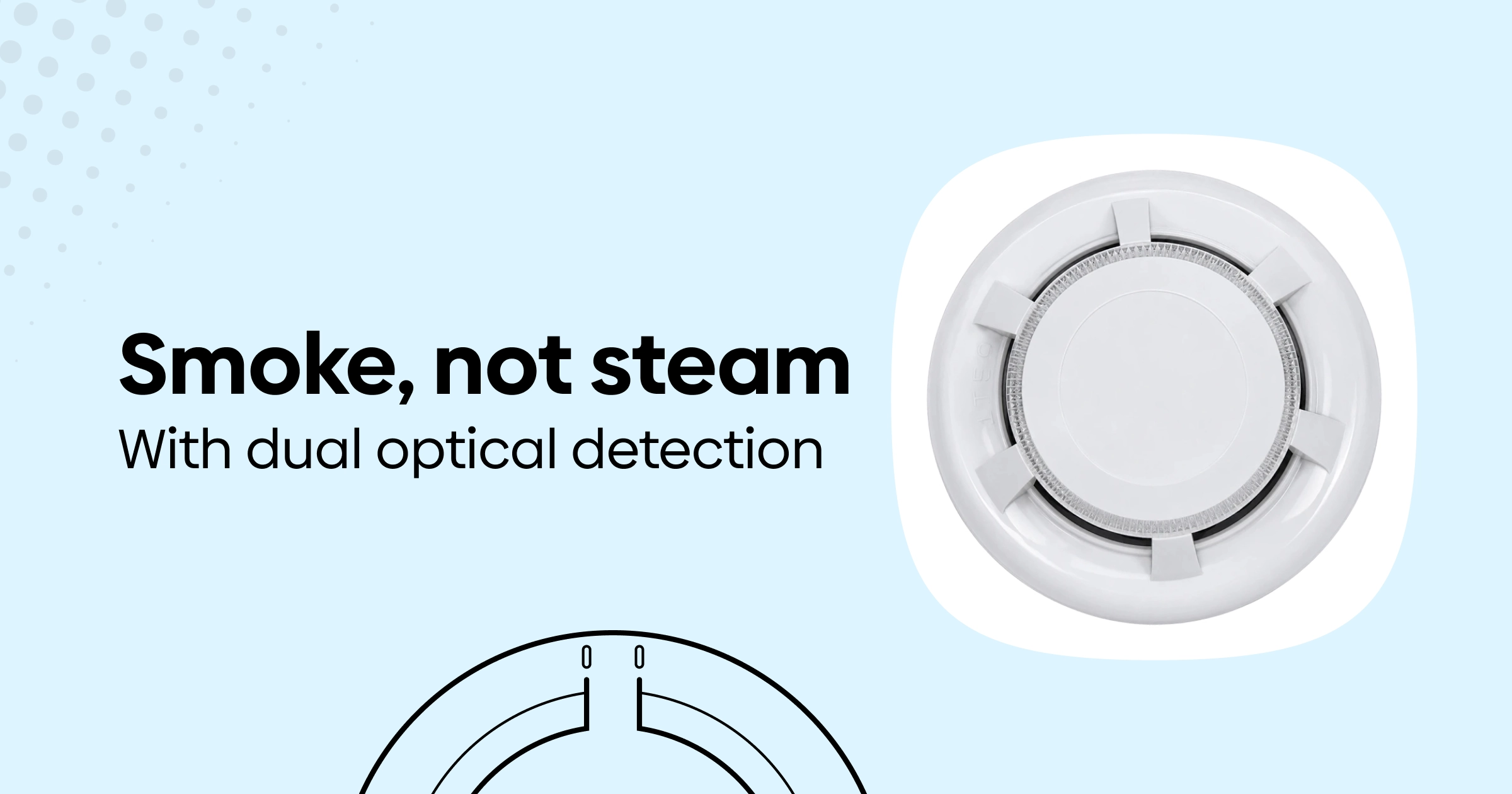
False alarms are one of the most persistent headaches on any fire system you maintain. In hotels, student accommodation and other high-occupancy buildings, a detector that can’t tell shower steam from smoke means repeated evacuations, call-out charges, wasted staff time – and, over time, occupants who stop taking the alarm seriously. Nittan’s Evolution EV-DP dual optical detector is designed to tackle exactly this problem at source.
Why standard optical detectors struggle
A conventional optical smoke detector works on the scattered light principle: an infrared (IR) light source inside the sensing chamber illuminates airborne particles, and the detector responds to the light they scatter. The limitation is that the detector can’t tell what those particles are. Steam from a shower, aerosol sprays, vape vapour, condensation in a humid room – all of them scatter light in much the same way as smoke, and all of them can trigger an alarm.
In a plant room that’s rarely a problem. In an en-suite hotel corridor or a halls-of-residence landing, it’s a weekly one.
What dual optical technology does differently
The EV-DP uses two light sources of different wavelengths – infrared and blue light-emitting diodes (LEDs) – rather than one. The physics is straightforward: the difference in scattered light intensity between the two wavelengths shrinks as particle size increases relative to the wavelength. Because smoke particles are generally much smaller than steam droplets or dust, comparing the ratio of the two signals lets the detector estimate particle size and discriminate genuine combustion products from harmless environmental particles.
The result is a detector that remains sensitive to combustion products while reducing the everyday triggers behind many nuisance activations. The technology is patented and unique to Nittan.
Nittan reports the detector has been tested in real-world steam scenarios, including a University of East Anglia student accommodation installation where EV-DP detectors were used to address repeated false alarms from bathroom steam.
Built for humid environments
Steam-prone areas need careful detector selection. The EV-DP is rated for up to 95% relative humidity in non-condensing conditions, so it is best specified in areas adjacent to bathrooms and showers where steam reaches detectors, rather than inside wet rooms or locations subject to condensation.
Nittan engineers the EV-DP‘s printed circuit boards (PCBs) to marine-grade standards, where reliable performance in harsh, demanding environments is non-negotiable. The specially conformal-coated PCBs protect against moisture ingress and condensation, supporting long-term reliability and consistent performance even in high-humidity areas like hotel bathrooms.
Where it fits on your next install
The EV-DP is an addressable detector on Nittan’s Evolution protocol, so it’s specified where you’re running an Evolution loop. The obvious applications:
Hotels – corridors and rooms adjacent to en-suites, where shower steam is the classic nuisance trigger
Student accommodation and HMOs – vaping and aerosol use are near-impossible to police; detection that is less prone to false alarms from non-combustion aerosols is easier than enforcement
Hospitals and care settings – where evacuation is disruptive and every false activation carries real operational cost
For the responsible person, fewer false alarms isn’t just convenience. BS 5839-1:2025 places clear emphasis on limiting false alarms and unwanted fire alarm signals, and a system that keeps activating without cause is a system heading for a management review. Specifying discrimination at the detector level is the cleanest fix.
The detector is certified to EN 54-7:2018 and requires a separate mounting base, with compatible options including the standard UB-6-EV, the EV-B-SCI short circuit isolator base and the deep STB-4SE-EV.