Most people know they should have some form of fire cover close to hand. The problem is what that usually means in practice: a pressurised cylinder that is bulky, needs servicing, leaves a mess if it is used, and often ends up exactly where it is least useful.
For installers and engineers, that problem is familiar. You take fire seriously at work, but the van, the garage, the kitchen cupboard, the caravan locker or the weekend car can still be the place where proper first-response equipment gets missed.
That is where the Fire Safety Stick is worth a look.
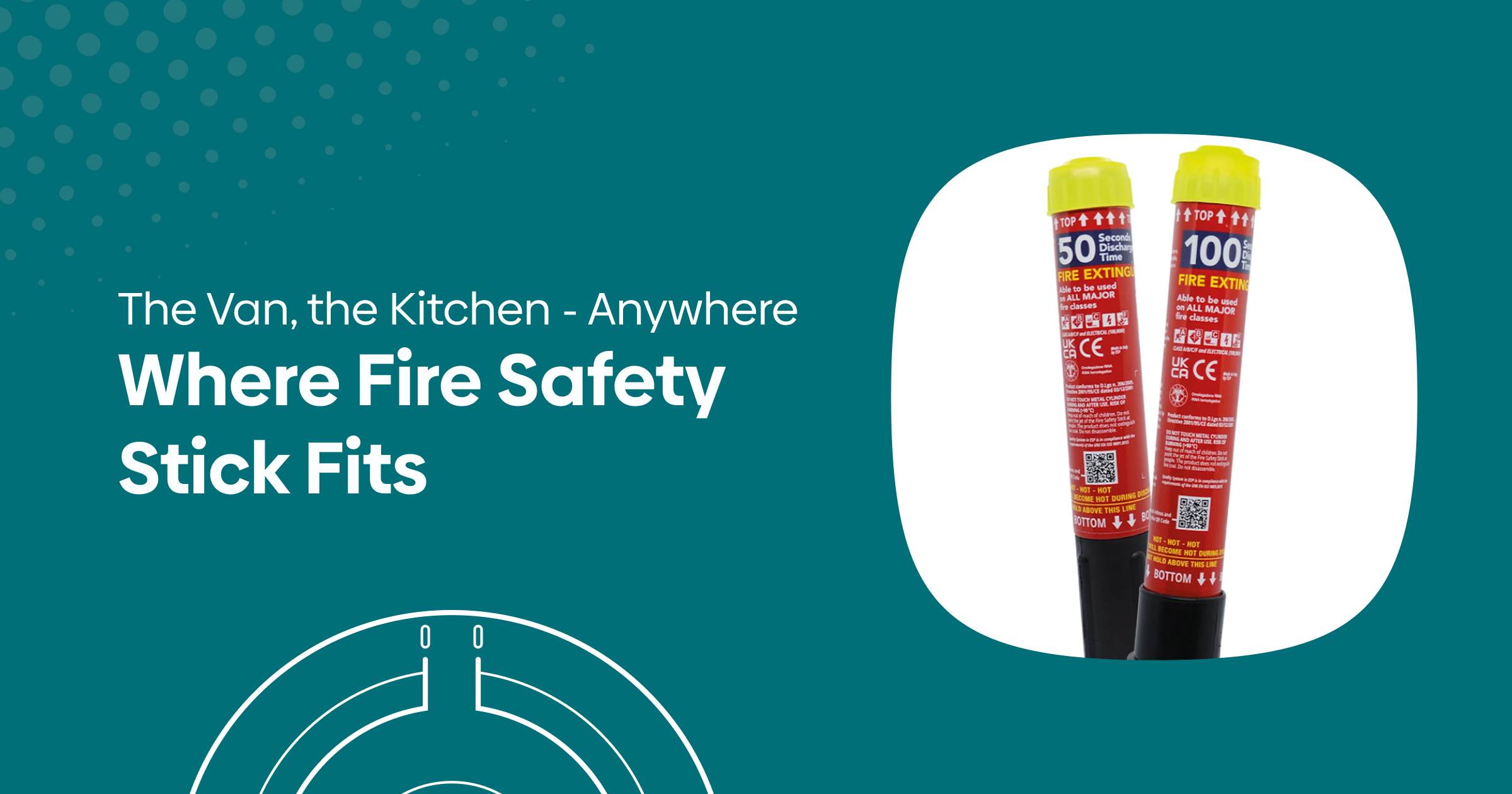
The Fire Safety Stick is a compact, non-pressurised aerosol extinguisher designed for early-stage fires. Huvo stocks the 50-second FSS50 and the larger 100-second FSS100, giving you a long discharge time in a unit that is small enough to carry, mount or keep nearby without turning it into a job of its own.
In England alone, fire and rescue services attended 19,600 primary road vehicle fires and 26,180 dwelling fires in the year ending March 2026. You hope never to need one. But if a small fire starts in the seconds before help arrives, having something close to hand matters.
What makes it different?
A conventional dry powder extinguisher has its place, but it is not always the product people want to keep in a vehicle, kitchen or restored car interior. It is heavy, pressurised, requires regular servicing, and the powder can leave a corrosive residue across wiring, electronics, machinery and trim.
The Fire Safety Stick takes a different approach. When activated, it produces an aerosol that interrupts the chemical reaction of fire. There is no pressurised cylinder, no powder discharge and no corrosive residue left behind.
The FSS50 is 270mm long, 35mm wide and weighs 215g. The FSS100 is 330mm long, 40mm wide and weighs 365g. Both are service-free for 15+ years and certified for Class A, B, C and F fires, plus electrical fires up to 100,000 volts.
That makes it a useful option for vehicles, kitchens, workshops, garages, motorhomes, caravans and other places where a standard extinguisher often gets left out because it is too awkward to store or maintain.
One for the van
Most trade vans do not carry an extinguisher. Not because engineers do not understand the risk, but because the practicalities get in the way.
A van might carry fuel, batteries, chargers, solvents, power tools and thousands of pounds of equipment. But a 2kg cylinder rolling around the load bay is a nuisance, and if it is ever discharged near tools or test equipment, the clean-up can become a problem of its own.
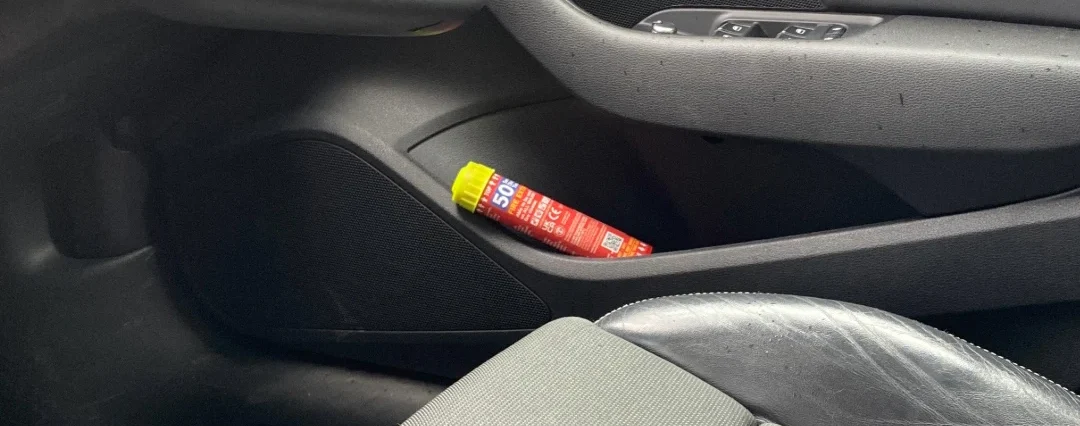
The FSS50 is small enough for a door pocket, glove box or bulkhead clip, while the FSS100 gives a longer discharge time for larger vehicles or load areas. For an early-stage wiring, fuel or engine bay fire, the difference between a short burst and a longer discharge can be the difference between knocking something back and actually buying time.
This is not about replacing the fire safety provision required by a risk assessment. It is about having a practical first-response option in the places where conventional extinguishers often do not get carried at all.
One for the weekend machine
Plenty of people in the trade spend the week installing fire and security systems, then the weekend under a bonnet, in a paddock, towing a caravan or looking after a classic car.
Those are exactly the places where dry powder can be a difficult sell. If you have restored an interior, built a wiring loom or prepared a vehicle for an event, the thought of discharging corrosive powder through it is not appealing. In many cases, the clean-up can do almost as much damage as the fire.
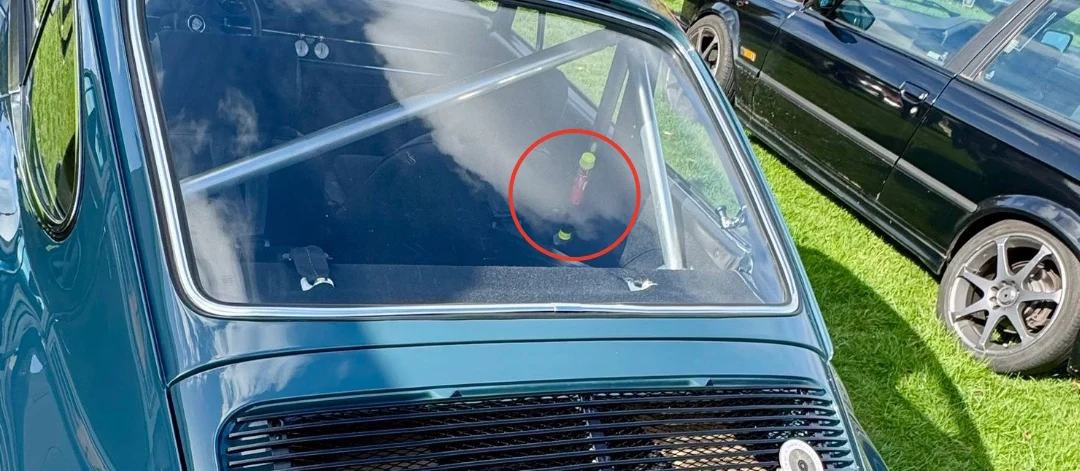
The Fire Safety Stick is compact enough to mount where it can actually be reached: on a roll bar, near a driver’s position, in a caravan locker, in a motorhome or in a garage. It is non-pressurised, has no moving parts, and can sit there without annual servicing becoming another job on the list.
For motorsport, it should sit alongside whatever extinguisher provision your championship or event rules require. It should not be treated as a replacement for those requirements unless the relevant regulations say so. But for personal vehicles, classic cars, touring set-ups and garages, it gives you a clean, compact option for the early moments of a fire.
One for the kitchen cupboard
Domestic fire safety usually starts with detection, and rightly so. Smoke and heat alarms warn the household and give people time to get out.
But once detection is covered, homeowners often ask the same question: what else should we have?
The technically correct answer might include a suitable extinguisher and a fire blanket. The practical issue is whether those products end up somewhere useful. A conventional extinguisher can feel too large for a kitchen, needs attention over time, and often gets moved to a garage or utility room where it is no help during a cooking fire.
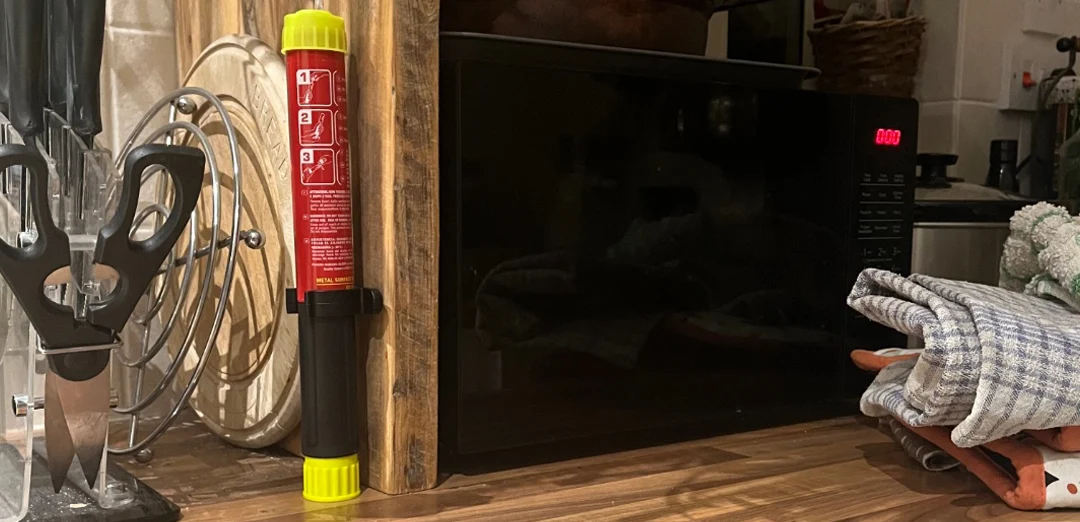
The FSS50 is small enough to mount inside a cupboard door or keep close to the area where it may actually be needed. It covers cooking oils and fats, solid materials, flammable liquids and gases, and electrical fires, with a minimum 50-second discharge time.
For domestic installers, that makes it a natural add-on conversation. Detection tells the household there is a fire. A first-response extinguisher gives them something to use on a small, early-stage fire if it is safe to do so, while escape remains the priority.
The honest limitations
The Fire Safety Stick is useful, but it is not magic, and it should not be sold as if it is.
It is designed for early-stage fires. If a fire is established, spreading quickly, or the route out is at risk, the answer is evacuation and calling the fire service, not staying to fight it.
It is not certified for lithium-ion battery fires, coal or charcoal fires. It should also be treated as a complement to conventional extinguisher provision, not a like-for-like replacement for whatever a fire risk assessment, site policy or governing body requires.
That honesty matters. The product is strongest when it is positioned properly: compact, clean, long-discharge first-response fire cover for the places where people are most likely to keep it within reach.
FSS50 or FSS100?
For glove boxes, kitchen cupboards, small vehicles, tool bags and compact mounting positions, the FSS50 is the obvious starting point. It gives a 50-second discharge time in a 215g unit roughly the size of a torch.
For larger vehicles, vans, workshops, motorhomes, plant rooms, server racks, garages and places where a longer discharge time makes sense, the FSS100 doubles that discharge time to 100 seconds while still weighing only 365g.
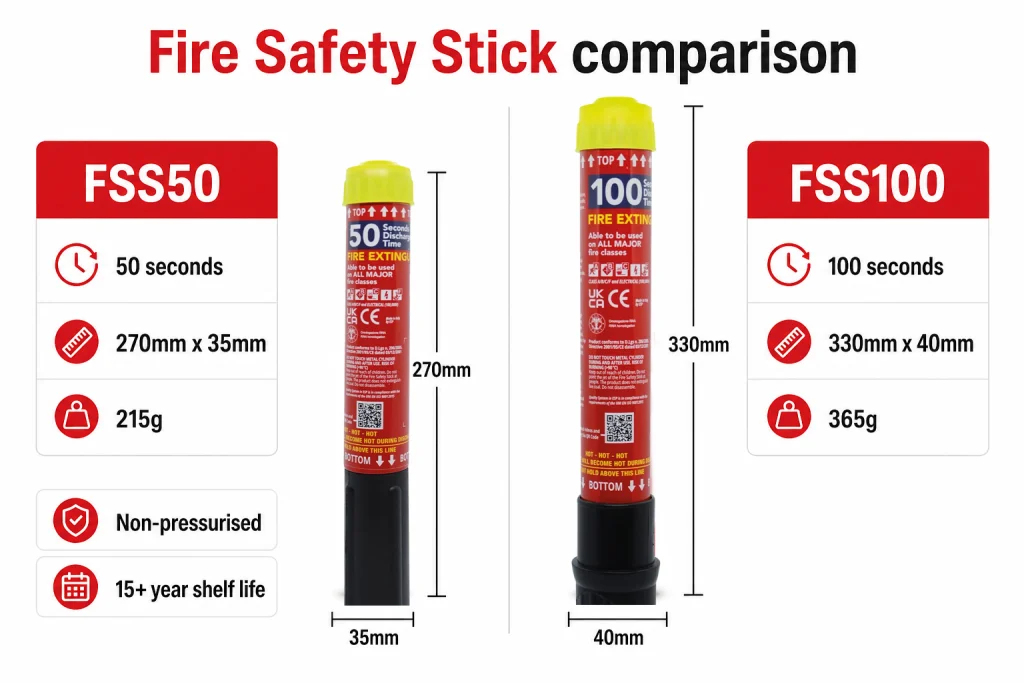
Both models are in stock at Huvo: Fire Safety Stick, 50 Seconds and Fire Safety Stick, 100 Seconds.
If you are not sure which model fits your application, or where the Fire Safety Stick sits alongside existing extinguisher provision, speak to the Huvo team. We will give you a straight answer before you order.
Call us on 01792 983 170 or email [email protected].