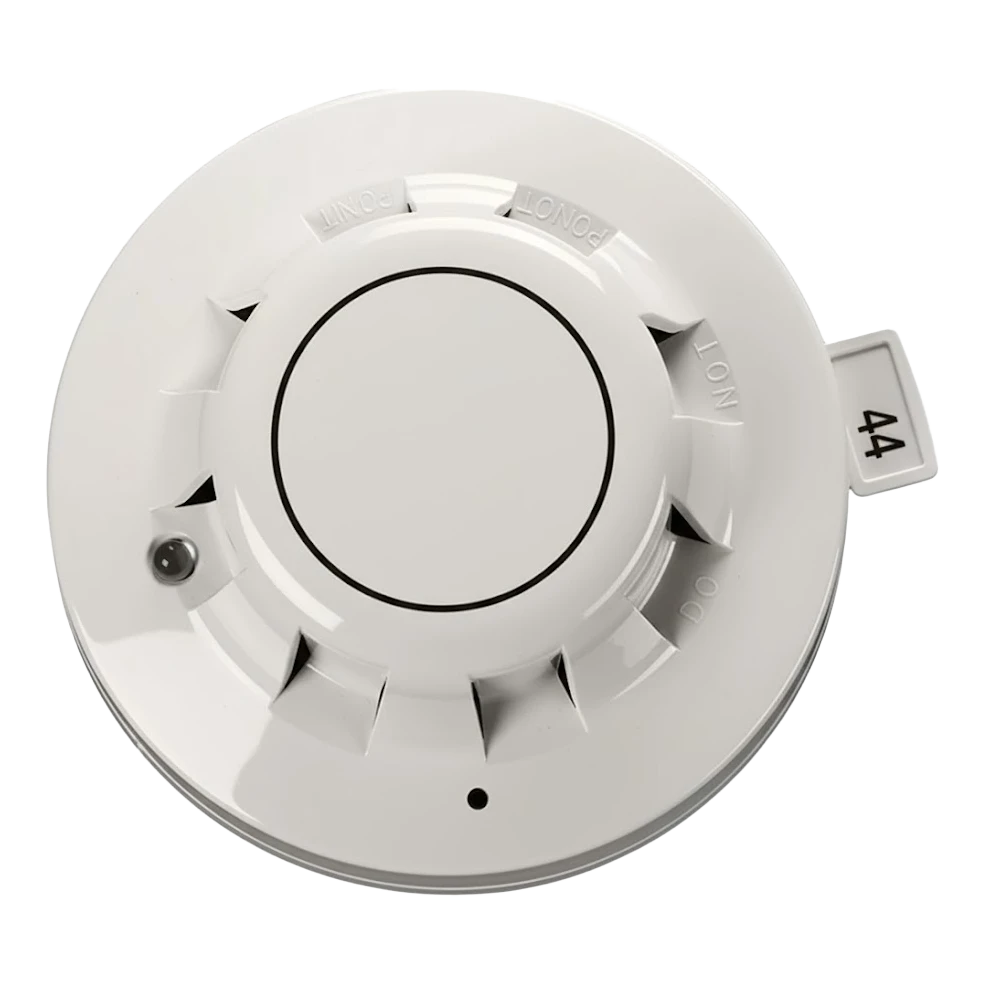
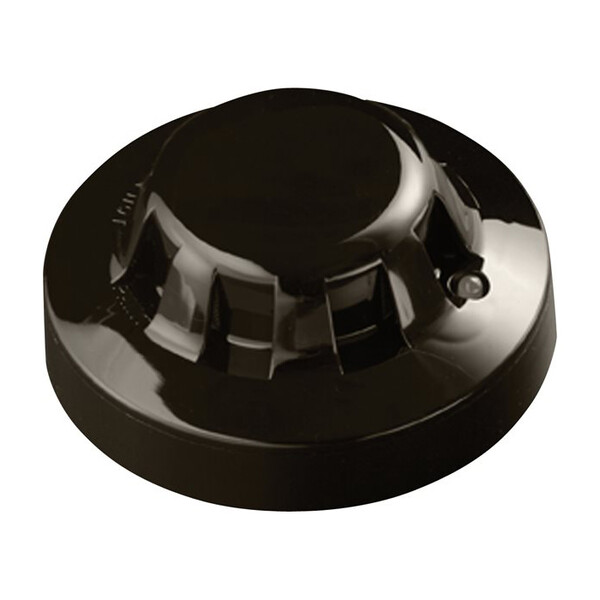

Apollo 55000-660/600 XP95 Addressable Optical Smoke Detector
You may also need
Key features
- XPERT addressing through a compatible base
- Connection for a remote alarm indicator
- Polarity-insensitive two-wire loop connection
Downloads
Summary
The Apollo XP95 Optical Smoke Detector uses photoelectric light scattering to detect slow-burning and smouldering fires on a compatible addressable fire alarm loop. Apollo identifies it as well suited to escape routes, where this smoke-detection response is useful.
View full overview Show less
Choose White for model 55000-600 or Black for model 55000-660. Both use the same detection principle and share the electrical ratings and dimensions shown below, so you can select the required finish without changing the detector specification.
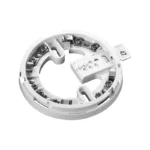
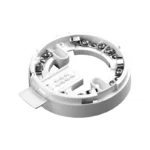
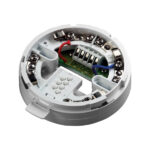
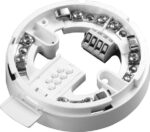
The detector samples once per second and communicates over a two-wire loop carrying power and data. It requires a compatible mounting base: standard XPERT 7 options include white 45681-210 and black 45681-361, with the detector address set using the base’s XPERT card. Confirm that your panel supports the exact detector before selecting it for a new installation or replacement.
Features
- Smouldering-fire detection - forward light scattering detects smoke particles, with escape routes among Apollo’s stated applications
- Base-set addressing - a compatible XPERT base carries the address card used by the detector
- Two-wire loop connection - power and data share the loop, with polarity-insensitive L1/L2 connections
- Remote indication - dedicated +R and -R terminals support a suitable remote light-emitting diode (LED) indicator
- Regular smoke sampling - the optical chamber samples once per second and the detector’s clear indicator lights red in alarm
- Two housing finishes - select 55000-600 in white or 55000-660 in black to suit the installation
FAQ
Select White for Apollo 55000-600 or Black for Apollo 55000-660. These are the two model choices on this listing; both share the detection principle, electrical ratings and dimensions shown in the specification table. Use a compatible Apollo mounting base. Standard XPERT 7 options are 45681-210 in white and 45681-361 in black; choose the base appropriate to your installation. Base options are listed in the You may also need section. The address is set with the XPERT card in the compatible mounting base. Use Apollo’s base installation guide and address chart to remove the pips for the required address, then fit the card as instructed. When replacing a detector head, check the existing base and its address card as part of commissioning. Apollo lists XP95, Discovery and CoreProtocol compatibility, but your panel must support the exact detector model and system configuration. The detector connects through its mounting base to a two-wire loop carrying data and a 17-28V DC supply, using polarity-insensitive L1/L2 connections. Follow the panel and base installation instructions; protocol compatibility alone does not confirm suitability for every panel. No. Apollo states that wind and atmospheric pressure do not affect the detector, but its operating limits remain -20°C to +60°C and 0-95% relative humidity, with no condensation or icing. Assess the proposed location and fire-detection application against those limits rather than treating the wind rating as unrestricted environmental suitability. Yes, a suitable remote LED indicator connects to the +R and -R terminals in the mounting base. Apollo specifies a standard high-efficiency red LED requiring no more than 4mA at 5V. Its datasheet states that no external series limiting resistor is required because the detector limits the current internally.Which XP95 optical model does each colour option supply?
Which mounting base does the detector need?
How do I set the detector address?
Will it work with my panel, and how is it wired?
Does the wind rating mean it suits any environment?
Can I connect a remote alarm indicator?
Specifications
| Product Type | XP95 addressable optical smoke detector |
|---|---|
| Model And Colour (per model) | 55000-600: White; 55000-660: Black |
| Detection Principle | Photoelectric detection of forward-scattered light from smoke particles |
| Optical Chamber | Horizontal optical bench with a radially arranged infrared emitter and sensor; lightproof labyrinth with integral gauze |
| Sensor | Silicon PIN photodiode |
| Emitter | Gallium arsenide (GaAs) infrared LED |
| Sampling Frequency | Once per second |
| Nominal Response Threshold | 0.12dB/m |
| Nominal Clean-Air Analogue Value | 25 ±7 counts |
| Analogue Alarm Level | 55 counts |
| Digital Communication | XP95, Discovery and CoreProtocol compatible; exact panel compatibility must be checked |
| Supply Voltage | 17-28V DC |
| Supply Wiring | Two-wire loop carrying power and data; polarity insensitive |
| Loop Terminals | L1 and L2 in the mounting base |
| Remote Indicator Terminals | +R positive and -R negative; datasheet lists an internal 2.2kΩ connection to each respective supply rail |
| Protocol Voltage | 5-9V peak to peak |
| Quiescent Current | 340µA |
| Power-Up Surge Current | 1mA for 1 second (Apollo datasheet PP2610/2021 Issue 2) |
| Maximum Power-Up Time | 4 seconds (Apollo current product data) |
| Alarm Indicator | Clear LED emitting red light in alarm |
| Alarm LED Current | 4mA |
| Remote LED Current Rating | 5mA maximum in the datasheet technical table; see FAQ for the separate indicator selection requirement |
| Operating Temperature | -20°C to +60°C |
| Storage Temperature | -30°C to +80°C |
| Humidity | 0-95% relative humidity; no condensation or icing |
| Effect Of Wind And Atmospheric Pressure | Unaffected, within the stated environmental limits |
| Dimensions | 100mm diameter x 42mm height (detector) |
| Weight | 105g (detector) |
| Housing Material | Polycarbonate |
| Terminal Material | Nickel-plated stainless steel |
| Standard Base Options | XPERT 7: 45681-210 White; 45681-361 Black |
| Addressing | XPERT address card in a compatible base |
| Standards And Approvals | EN 54-7; CPR and LPCB for 55000-600 and 55000-660, as listed in Apollo datasheet PP2610/2021 Issue 2 |
| Specification Reference Conditions | Datasheet figures are typical at 24V, 25°C and 50% relative humidity unless otherwise stated |
Downloads
- Datasheet (Adobe PDF)
More Detector products from Apollo
Apollo Discovery Optical Smoke Detector
£35.81 (inc VAT: £42.97)
Apollo Soteria Dimension Optical Smoke Detector
£171.60 (inc VAT: £205.92)
Soteria SA5000-600 Optical Smoke Detector
£42.70 (inc VAT: £51.24)
Apollo 58000-305 Discovery CO & Heat Multisensor Detector
£62.44 (inc VAT: £74.93)
Apollo 58000-700 | Discovery Multisensor Detector | Optical Smoke & Heat
£44.32 (inc VAT: £53.18)
Apollo Discovery 58000-300 Carbon Monoxide Detector
£61.46 (inc VAT: £73.75)
Apollo Discovery Heat Detector
£37.73 (inc VAT: £45.28)