


Interlinked Smoke Alarms UK — How They Work, Types and Which to Choose
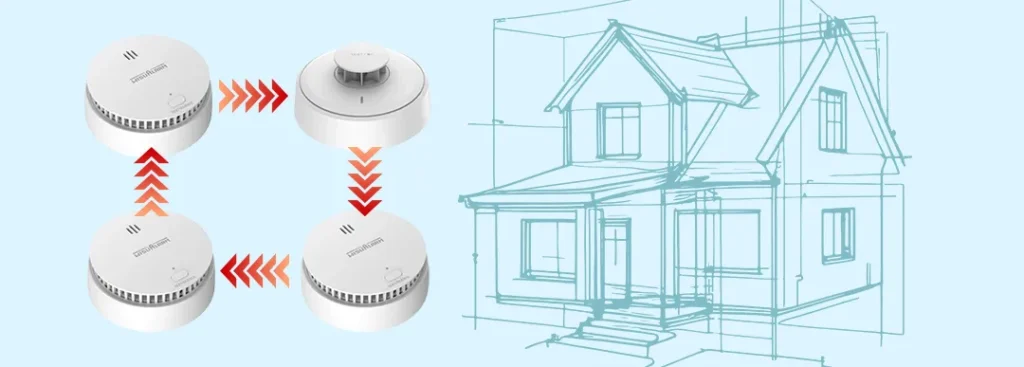
Interlinked smoke alarms are designed so that when one alarm detects smoke, all alarms in the property sound at the same time. This ensures that occupants are alerted regardless of where a fire starts, which is particularly important in multi-storey homes and larger properties.
The practical result is that a fire starting in a ground floor kitchen will immediately alert everyone in every bedroom upstairs, giving occupants the maximum possible time to escape. Without interlinking, an alarm in the kitchen would only sound in the kitchen.
In the UK, interlinked alarms are a legal requirement in all homes in Scotland and in rented homes in Wales. In England they are strongly recommended and increasingly expected in rental properties, though not always explicitly mandated. This page explains how interlinked smoke alarms work, the different types available and how to choose the right system for your property.
Huvo has been supplying interlinked fire alarm systems to UK homes and businesses since 2012.
What are interlinked smoke alarms?
Interlinked smoke alarms are connected so that activation of one alarm triggers all alarms within the system. This connection can be achieved through physical wiring or wireless communication depending on the system type.
Unlike standalone alarms which only sound locally, interlinked systems provide full-property coverage and significantly improve the likelihood that all occupants will hear the alarm in time to respond, wherever they are in the property.
Why interlinked alarms are used
Interlinked systems improve safety by ensuring that a fire detected in one part of the property is immediately communicated throughout the entire building. This is particularly important in multi-storey homes where occupants may be on different floors, in larger properties where rooms are remote from each other and in any property where occupants may be asleep and unable to hear a localised alarm.
By linking all alarms together the system provides a consistent and immediate warning regardless of where the fire begins. This is why interlinked systems are now considered standard practice in domestic fire alarm installation across the UK.
For landlords, interlinked systems are strongly recommended in England and are increasingly specified as a condition of letting agent agreements and landlord insurance policies. In Wales they are a legal requirement for rented homes, and in Scotland a legal requirement in all properties regardless of tenure.
Where interlinked alarms are required
In Scotland, interlinked smoke alarms are a legal requirement in all homes regardless of whether the property is owned or rented. This has been the case since February 2022 and applies to all residential properties.
In England, the Smoke and Carbon Monoxide Alarm Regulations 2022 require landlords to install smoke alarms on every storey of a rental property. While interlinked alarms are not always explicitly mandated in England, they are strongly recommended and are increasingly expected by local councils, letting agents and HMO licensing bodies. They are considered best practice for all rental properties.
In Wales, the Renting Homes (Fitness for Human Habitation) (Wales) Regulations 2022 require rented homes to have mains-connected, interlinked smoke alarms on every storey. Interlinking is a legal requirement for Welsh rental properties, not simply a recommendation.
For full guidance on placement and where alarms should be positioned within the property see our Smoke Alarm Placement Guide.
Scotland — specific requirements
Scotland has the most comprehensive interlinked alarm requirements in the UK. Since February 2022 all homes in Scotland must have a smoke alarm in the room most frequently used during the day, which is typically the main living room, a smoke alarm in every hallway and landing, a heat alarm in the kitchen and a carbon monoxide alarm where a fixed combustion appliance or flue is present. All alarms must be interlinked.
These requirements apply to all homes in Scotland regardless of whether the property is owned or rented. For Scottish landlords compliance is a legal obligation and failure to meet the requirements can affect licensing and insurance.

Landlords and interlinked alarms
For landlords across the UK, interlinked alarm systems are the recommended and increasingly expected standard for rental properties.
In England, while interlinked systems are not always explicitly required by legislation, they are widely specified by letting agents, local authorities and HMO licensing bodies as a condition of letting or licensing. In Wales, they are a legal requirement for rented homes under the Renting Homes (Fitness for Human Habitation) (Wales) Regulations 2022. Many landlord insurance policies also specify interlinked alarms as a requirement.
In Scotland, interlinked alarms are a legal requirement in all properties including rental properties. Landlords must ensure the system is installed and working and must be able to demonstrate compliance.
For landlords managing multiple properties, standardising on a single interlinked system across all properties simplifies compliance, testing and maintenance. Our System Finder can provide a recommended layout for a typical property that can be replicated across a portfolio.
For full landlord guidance see our Landlord Fire Alarm Requirements page.
How interlinked systems work
Interlinked smoke alarms communicate with each other so that when one alarm detects smoke, heat or carbon monoxide, all alarms in the system activate at the same time. This connection can be made through wiring between alarms or through wireless radio frequency communication depending on the system type.
The result is a consistent alert throughout the entire property regardless of where a fire starts. An alarm activating in a ground floor utility room will immediately trigger every alarm in every bedroom on every floor above it simultaneously.
For mains-powered Grade D1 systems in retrofit situations where interlink wiring is not available between alarm positions, wireless RF modules can be added to each alarm to connect them without additional wiring. This allows a mains-powered system to be installed in an existing property without the need to run new interlink cables between alarms.
Wired, wireless and D1 with RF modules
There are three main approaches to achieving interlinked alarm systems in domestic properties. Understanding the differences helps you choose the right option for your installation.
| System type | How it works | Best suited to |
|---|---|---|
| Wired interlinked systems | Use cabling between alarms to carry the interlink signal. | New builds and major renovations where wiring can be installed at the same time as the alarms. |
| Wireless interlinked systems | Use radio frequency communication between alarms and require no additional wiring. | Existing properties where running new cables is not practical. |
| Grade D1 with RF modules | Uses mains-powered alarms with wireless RF modules added to carry the interlink signal. | Existing properties where mains-powered alarms are preferred but interlink wiring is not available. |
Both wired and wireless approaches provide the same core functionality. The choice depends primarily on the installation environment and whether mains wiring is available.
Typical domestic setups
Most domestic fire alarm systems combine smoke alarms in escape routes, a heat alarm in the kitchen and CO alarms where required, all interlinked to ensure whole-property alerting. The specific configuration depends on the number of floors, the layout and the location of the property.
| Property type | Typical setup |
|---|---|
| One floor property | One smoke alarm in the hallway, one heat alarm in the kitchen and CO alarms in any rooms with fuel-burning appliances, all interlinked. |
| Two floor property | A smoke alarm in the ground floor hallway, a smoke alarm on the first floor landing, a heat alarm in the kitchen and CO alarms where required, all interlinked. |
| Three or more floors | A smoke alarm on each floor in the main circulation space, a heat alarm in the kitchen and CO alarms where required, all interlinked. |
| Scotland | A smoke alarm in the main living room is also required in addition to the above on every floor. |
These setups reflect standard LD2 protection covering escape routes and high-risk areas. Additional smoke alarms in living rooms and bedrooms provide a higher level of LD1 protection and can be added as optional extensions to any of the above configurations.
Products
The following interlinked alarms and systems are suitable for domestic properties. Products are compatible with interlinked setups and can be selected based on your preferred installation method.
Each product should clearly indicate interlink capability, system type, and grade where applicable.
The Wisualarm range offers wireless interlinked alarms with infrared remote silencing, allowing any alarm in the system to be silenced quickly from floor level without reaching the unit directly. This makes the Wisualarm range a practical choice for all property types including those with elderly or less mobile occupants.
RF wireless interconnect modules are also available for Grade D1 mains-powered systems where interlink wiring is not available between alarm positions.
Choosing the right system
The right interlinked system depends on whether wiring is available, the size and layout of the property and whether a fixed or flexible installation is preferred.
If a qualified electrician is carrying out the installation in a new build or fully rewired property, a hardwired Grade D1 interlinked system is the standard choice. It provides the most reliable long-term solution with mains power and sealed battery backup.
If wiring is not available or not practical, a Grade F1 wireless interlinked system is the recommended alternative. All alarms interconnect wirelessly as standard and no additional modules or wiring are required.
If a mains-powered system is preferred in an existing property where running interlink wiring between alarm positions is not practical, a Grade D1 system with wireless RF modules combines the reliability of mains power with the installation flexibility of wireless interconnection.
For more information on system grades see our Fire Alarm Grades guide.
Frequently asked questions
Do smoke alarms have to be interlinked in the UK?
In Scotland, interlinked alarms are a legal requirement in all homes regardless of tenure. In Wales, they are legally required in rented properties under the Renting Homes (Fitness for Human Habitation) (Wales) Regulations 2022. In England, they are strongly recommended and increasingly expected in rental properties but not always explicitly required by legislation. For owner-occupied homes in England and Wales, interlinking is best-practice rather than a legal requirement.
Wired interlinked alarms are connected using cables between each alarm and are typically used in new installations where wiring can be run during the build or renovation. Wireless interlinked alarms communicate using radio frequency signals and require no additional wiring, making them suitable for existing properties where running cables is not practical.What is the difference between wired and wireless interlinked alarms?
Yes. For mains-powered Grade D1 systems where interlink wiring is not available between all alarm positions, wireless RF modules can be added to each alarm to carry the interlink signal without additional wiring. Your electrician will confirm on site whether RF modules are needed based on the available wiring.Can I add wireless modules to a wired system?
The number depends on the size and layout of your property. As a minimum, one smoke alarm is needed on each floor in the main escape route plus a heat alarm in the kitchen, all interlinked. Use our System Finder to get a specific recommendation based on your property.How many interlinked alarms do I need?
In Scotland, interlinked alarms are required by law in all homes regardless of tenure. In Wales, they are legally required in rented properties under the Renting Homes (Fitness for Human Habitation) (Wales) Regulations 2022. In England, they are strongly recommended for rentals but not explicitly mandated. Interlinking is not currently a legal requirement for owner-occupied homes in England or Wales, though it is strongly recommended.Are interlinked alarms required by law?
Yes. Both wired and wireless interlinked systems are designed to work throughout the property including between floors. When any alarm in the system activates, all alarms on every floor sound simultaneously.Do interlinked alarms work between floors?
Generally no. Interlinked alarms are designed to communicate within their own system and mixing brands can result in alarms that do not interlink correctly. Always use alarms from the same system range to ensure reliable interconnection. If you are adding to an existing system, check compatibility with the manufacturer before purchasing.Can I mix different brands of interlinked alarms?
Infrared remote silencing, available on the Wisualarm range, allows any alarm in the system to be silenced quickly from floor level without needing to reach the alarm directly. This is particularly useful in properties with elderly or less mobile occupants and removes the need to stand on a chair or use a ladder to silence a nuisance activation.What is the benefit of infrared remote silencing on interlinked alarms?
Not sure which interlinked system is right for your property? The System Finder takes your property details, number of floors, location and installation setup into account and recommends the right system in under a minute.
Find the right interlinked system for your property
Start System Finder